|  | Know better. Do better. |  | Policy, honestlyThe real-life impacts of policy decisions |
|
| | | By Lauren Crosby Medlicott | Freelance journalist | | |
|  |
| The policyIn the UK, the ‘Right to Buy’ scheme was introduced by then Conservative Prime Minister Margaret Thatcher in 1980, enabling tenants in public housing to buy their properties at rock-bottom prices.
It vastly expanded home ownership but depleted social housing stock. The scheme is now back in the news with details of Labour government proposals to introduce sweeping changes revealed last month against the backdrop of a housing crisis and a shortage of social housing.
The impact
The concept of social housing goes back a very long way in Britain. The country first began to offer housing to the disadvantaged at the turn of the 20th century when local authorities were funded by the central government to build affordable, secure homes.
“The idea was to provide sub-market level rented housing of good quality, to make sure people on low incomes could find decent … housing,” Professor Rebecca Tunstall, Joseph Rowntree Professor of Housing Policy at Cambridge University, told me.
“Local authorities were to allocate that housing to people they thought deserved it and would struggle elsewhere in the housing market.”
By 1939, 1.1 million homes had been built and 10% of the population lived in social housing. But after the second world war, governments were faced with the persistent problem of slums, the destruction of war, and the need to house returning soldiers, so they set out an even more ambitious vision for social protections.
Social housing quickly became abundant. 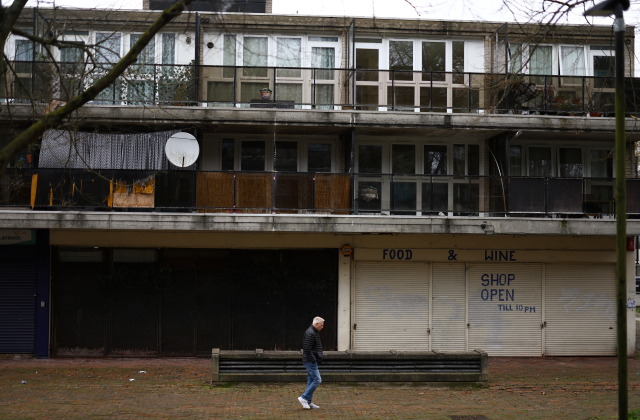 A man walks past closed down shops on a housing estate in south London, Britain, February 26, 2024. REUTERS/Hannah McKay |
Fast forward to today. Someone without a home turns up to a local government office where, in need of a decent-quality roof over their head, they meet with a homelessness team.
Perhaps it’s a lone adult working as a nurse, a couple with children trying to make ends meet, a recently recognised asylum seeker who has endured modern slavery, a single mother with young children, or a person with a disability.
But there’s a rub: instead of a house they might instead be offered a bed and breakfast, a hotel room, or some other form of temporary housing.
There is a lack of social housing to put them in partly because about two million social homes have been sold to tenants under Right to Buy since 1980.
And new building hasn’t kept up. In England for example, there are now 1.4 million fewer households in social housing than there were in 1980, according to housing charity Shelter. Local authorities have also seen their budgets cut over the years, exacerbating the problem. 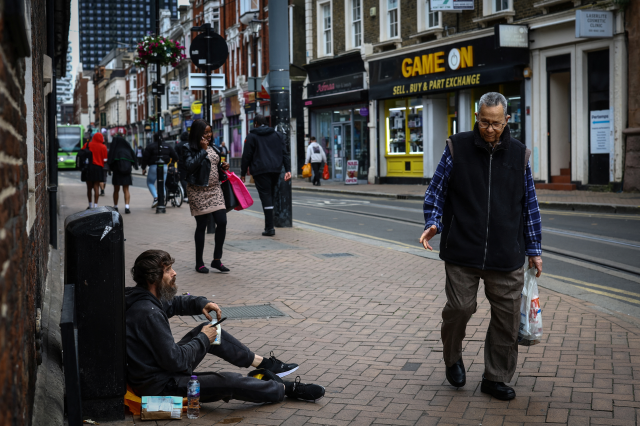 People walk past a man who is homeless on a high street in Croydon, south London, Britain, June 13, 2024. REUTERS/Hannah McKay |
Right to Buy has earned the government about £47bn over 40 years. But instead of using the money made by the sales of social housing to build more, most of it went into government coffers, housing experts and activists contend.
“While the treasury argues that part of this money has gone back into social housing investment, it’s impossible to say how much and it’s very unlikely to be more than half,” John Perry, policy advisor for the Chartered Institute of Housing, wrote in Inside Housing.
“In other words, Right to Buy is a money-earner that’s helping to keep down Britain’s deficit,” Perry said.
Hot potato
With less housing available, prices of private rentals have also risen, meaning there are fewer people who can afford housing on the private market. In turn, that puts added pressure on the social sector. It’s a vicious circle.
Due to its impact on social housing stock, the scheme was abolished in Scotland in 2016 and Wales in 2019.
Activists, though, have always believed it unlikely Right to Buy would be scrapped in England, saying it remains too much of a political hot potato.
So, what are the new Labour proposals for England?
Housing minister Angela Rayner appears to at least want to discourage people from buying their social houses. Tenants may now have to wait up to 10 years to buy their homes and those in newly built homes may never be allowed to buy them. 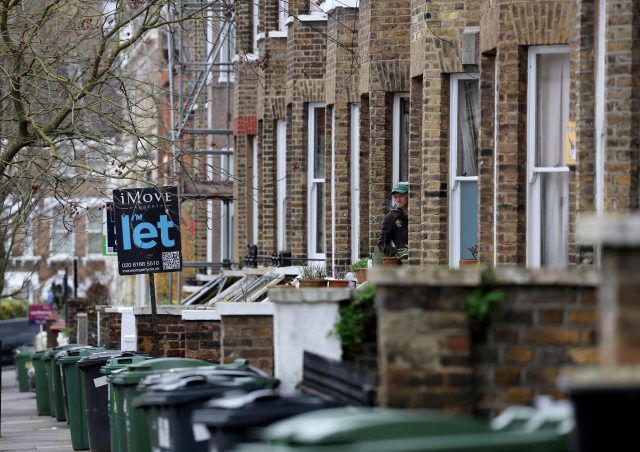 A man looks out from a house on a residential street in South London, Britain, February 26, 2024. REUTERS/Hannah McKay |
It also wants to reduce discounts to pre-2012 levels.
Not everyone is in favour, though. The opposition Conservative party has accused Labour of “pulling up the drawbridge” behind millions of aspiring homeowners and therefore limiting social mobility. Some defenders of the scheme have also argued it has allowed for the transfer of capital wealth from the state to the people.
"The Right to Buy has helped millions into home ownership. It has given something back to families who worked hard, paid their rent, and played by the rules," Conservative shadow housing secretary Kevin Hollinrake said.
According to a YouGov poll in 2021, 62% of Britons who don't own their own home said they'd like to own a home in the future.
But many housing activists are clear that reforms are needed.
“Providing safe and secure housing is the response we need right now, not trying to get council tenants to buy their properties,” Tunstall, the Cambridge professor, said.
Any views expressed in this newsletter are those of the author and not of Context or the Thomson Reuters Foundation. |
|
|
| | In Lebanon, a ceasefire brings relief but the battered education system will struggle to recover from war and economic collapse | The Israel-Hezbollah war revealed severe challenges for people with disabilities in a country where state institutions are failing | Call centres fuel the Philippines' economy, but AI threats, job insecurity, and low salaries plague the industry | |
| |
| | | |
|