 | Know better. Do better. |  | DataveillanceAI, privacy and surveillance in a watched world |
|
| | Welcome back to Dataveillance. I was recently surprised to learn the many ways that artificial intelligence and drones are being used to help farmers - from satellite monitoring for early drought to AI-powered cameras to detect threats on crops.
But it was most shocking to learn that drones are also being used to spread pesticides forcefully and harass small farmers off their lands in Brazil, according to a recent investigation by Mariana Tamari and Joana Varon, codirectors at Coding Rights, an organisation that advocates for human rights in tech’s use.
“This is a technology being used to instill fear into people, to intimidate them,” Tamari told me in a video call.
The research focuses on Matopiba, a region largely formed by Brazil's Cerrado, a vast tropical savannah that is home to a wide variety of wildlife and is a key source of water for much of South America.
There, AI-powered machines have become a tool in the fight to expand agricultural land, particularly for monoculture crops such as soy, corn and sugar cane – most of which are grown for export.
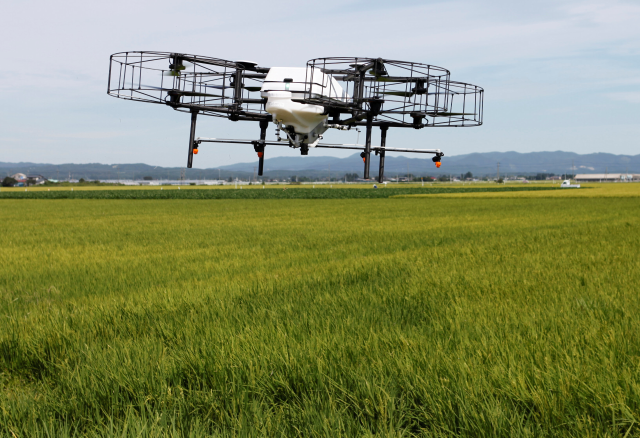 An automated drone flies over rice plants in Tome, Miyagi prefecture Japan August 20, 2018. REUTERS/Yuka Obayashi |
The researchers met with small farmers and human rights advocates who feared that drones are being used to spread pesticides over their lands without permission, killing their crops and polluting their water sources. The sight and sound of the unmanned aircraft also frighten the local population.
Drones are being used in a war-like manner, the research found, to boost illegal land seizure and deforestation in a region which has lost the most native vegetation in Brazil over the past two years, according to MapBiomas, a mapping initiative that tracks land use in Brazil.
“These are communities with little access to digital tech that suddenly find a drone outside their windows or their bathrooms. They feel this tech can surveil them, can attack them, can spread poison and pesticides over their lands and pulverize their homes,” said Tamari.
This is an episode in a much larger saga in Matopiba, where communities have been fighting for decades against illegal and aggressive attempts by powerful businesses to seize land, the research found.
Agriculture of the future
Intrigued by the link between tech and environmental justice, the researchers visited an agricultural fair in Brazil where tech companies showed their latest innovations – from remote-controlled machinery that can be used as if in a video game to sensors for data-based precision agriculture.
They found ads for “agro intelligence,” in which farm tractors are advertised as war tanks and tech is promoted as a solution for climate change and food insecurity.
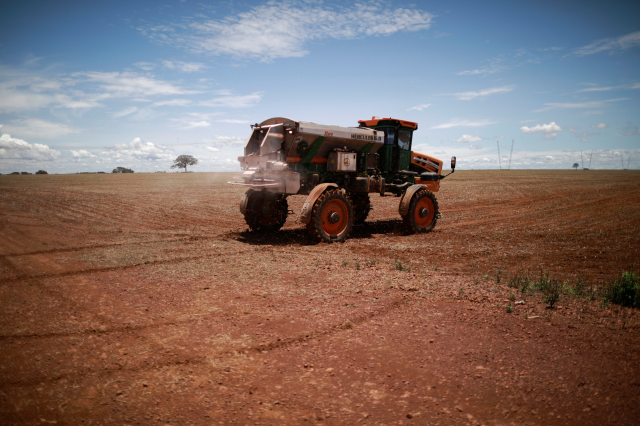 An agricultural worker drives a tractor spreading fertilizer in a soybean field, near Brasilia, Brazil February 15, 2022. REUTERS/Adriano Machado |
“A farm tractor is now connected to AI and precision agriculture (tools). It not only uses gasoline, but also data centres, water and energy. It produces two commodities: monocultures and data,” said Varon.
Products developed by big tech companies to solve complex, local issues usually leave out the needs of the communities and magnify existing problems like land-grabbing, said Varon.
Meanwhile, my colleagues at Context have documented interesting examples of tech developed by local communities to solve their agricultural issues.
For instance, drones are being used in Australia to pollinate food crops like tomatoes in covered environments such as glasshouses, where bees are not as effective and mechanical methods are labour-intensive and unreliable.
Local innovators in Africa are also developing fascinating tools like a solar-powered tool that uses AI and machine learning-enabled cameras to rapidly detect and alert farmers of pests and diseases.
For Tamari, communities’ control of these growing technologies is vital.
“This is a dispute against life’s extinction, because with these technologies there is no food diversity, there is no food sovereignty,” she said. |
|
|
|