The privatisation of the provision of asylum seeker housing, 2012.
The impact:
Vermin in bedrooms, abusive housemates, insecure locks, collapsing ceilings, damp, bed bugs. Horror stories about asylum seeker accommodation in the UK are not new.
But, over the last three years as asylum seekers have arrived from countries such as Afghanistan and Syria, things have arguably deteriorated even further.
There simply has not been enough housing for them, and the answer? Hotels.
At the end of 2020, there were 11,076 asylum seekers living in UK hotels. By the end of the next year, that had more than doubled to 26,380, according to a report from the Refugee Council. Many reported feeling suicidal and some had no access to essentials such as clothing and footwear, medicines, mobile phones and the internet.
Although hotel accommodation is supposed to be a temporary solution for asylum seekers, 378 people had been in those hotel rooms for a year and 2,826 had been there for more than six months at the end of 2021, the Refugee Council said.
Several policy decisions are key to understanding how we arrived here.
First, let’s go back to 1999. Before then, local authorities were responsible for housing asylum seekers in local communities. A dense population settled in London and southeast England and, to relieve pressure on these areas, a “dispersal policy” was introduced by the Immigration and Asylum Act 1999.
That decision effectively took the choice of where they would live away from asylum seekers.
Still, he said with concerted efforts by local authorities, third sector organisations and asylum support groups, “the picture did improve.” Far from perfect, but functioning.
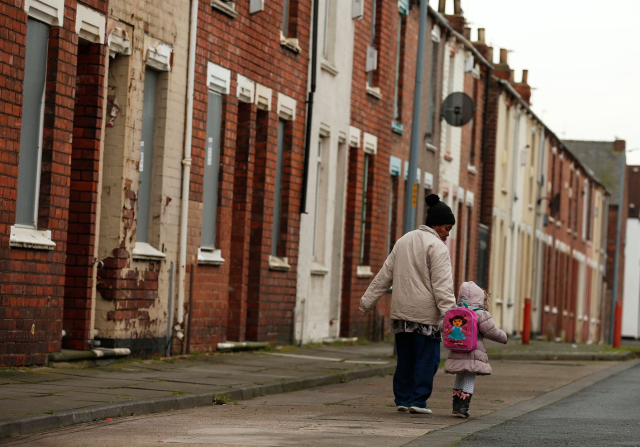
A woman and child walk along a terraced street in the Gresham area of Middlesbrough, northern Britain, January 20, 2016. Asylum seekers in the northern English town of Middlesbrough are suffering abuse because they have been housed in properties that almost all have red front doors, making them easy targets for racists. REUTERS/Phil Noble
Hostile environment
Next, we need to look to 2010. A new Conservative party government, led by Prime Minister David Cameron, came to power. Theresa May, a future prime minister, was appointed home secretary and in 2012 made an infamous statement. Her goal, she told the Daily Telegraph newspaper, “was to create here in Britain a really hostile environment for illegal migration”.
It worked, impacting everything from policy to public opinion. And, in March of that year, the provision of asylum seeker accommodation was privatised.
It appeared it would be an easier model for provision with just six central contracts, rather than a variety of agreements with local authorities and housing associations (which was what had been happening).
These three contractors - large security companies Serco, G4S, and Clearel - would be responsible for liaising with participating local authorities about suitable housing options, but only the local authorities who signed up to be involved.
“We have consistently raised concerns in the past about the poor standard of accommodation provided for many asylum seekers, and the situation has the potential to deteriorate further with very large super-regional contracts,” she said.
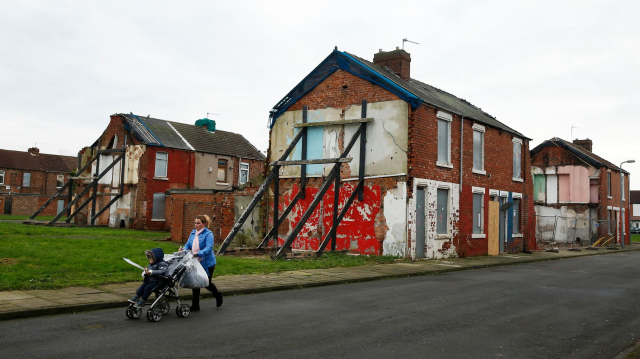
A woman pushes a pram along a semi-derelict terraced street in the Gresham area of Middlesbrough, northern Britain, January 20, 2016. Asylum seekers in the northern English town of Middlesbrough are suffering abuse because they have been housed in properties that almost all have red front doors, making them easy targets for racists. REUTERS/Phil Noble
Further traumatised
Since then, successive parliamentary reports have highlighted recurring problems posed by the contracting out of asylum accommodation.
The first major study of the system since privatisation, carried out in 2016 by the University of Manchester, said the system was geared toward making profits rather than the well-being of those it accommodates.
It resulted in an “increasingly fragmented” system, less support provisions for asylum seekers, gaps in addressing complaints, and a shortage of long-term planning and community integration.
Sub-standard accommodation became the norm, the report said, as asylum seekers were housed in the poorest parts of the UK, in the poorest quality houses, because cheaper housing meant more profit for the contractors.
Housing conditions for asylum seekers remain abysmal.
As a housing crisis in the UK grows worse, the big three contractors have decided to address the problem by putting asylum seekers in hotels for months on end.
Hotel accommodation is a danger to mental health, and ignores personal safety (particularly of women), cultural preferences and practical needs.
And, as things have deteriorated for those in need of help, Clearsprings, Cerco, and Mears continue to rake in massive profits. Serco reported £180m in profits in 2019. Mears said it cleared a £4.8m profit before tax in the second half of 2020. And Clearsprings’ operating profit went from £796,304 in January 2020 to £4.4m in January 2021.
While the contractors are to blame for inhumane living conditions, it is the government that is ultimately responsible for allowing the private sector to profit while asylum seekers suffer.
When we start treating asylum seekers as human beings, not as a business to make money from, change will happen. Until then, the status quo will continue, with some of the most traumatised people in our communities, traumatised even further through poor housing.
Any views expressed in this newsletter are those of the author and not of Context or the Thomson Reuters Foundation.
This email was sent to you by Thomson Reuters Foundation located at 5 Canada Square, Canary Wharf, London, E14 5AQ - a registered charity in the United Kingdom and the United States.
If you are not the intended recipient, be advised that you have received this email in error and that any use, dissemination, forwarding, printing or copying of this email is strictly prohibited. If you do not wish to receive this type of correspondence in the future, contact us at foundation@thomsonreuters.com so that we can remove you from this list.
Thomson Reuters Foundation terms and conditions and privacy statement can be found online at www.trust.org.
Photos courtesy of Reuters or Thomson Reuters Foundation.