|  | Know better. Do better. |  | Policy, honestlyThe real-life impacts of policy decisions |
|
| | This newsletter contains images that may be disturbing.
Harrowing images of malnourished children in Gaza have intensified international pressure on Israel to increase humanitarian aid to the enclave.
This week, Hamas-run health authorities in Gaza said that 93 children were among the 180 people who have already died from hunger-related causes. These deaths come on top of more than 60,000 Palestinians, mostly civilians, the health authorities in Gaza say have been killed since Israel launched its military offensive in the strip in October 2023.
Almost 470,000 people in Gaza are enduring famine-like conditions, according to the World Health Organization (WHO), with 90,000 women and children in need of specialist nutrition treatments. WHO chief Tedros Adhanom Ghebreyesus described the situation as “mass starvation” that was “man-made”, laying the blame squarely at the Israeli blockade.
While Israel has denied a policy of starvation, it controls most aspects of how food reaches and is distributed in Gaza. This includes access into Gaza, transport logistics and who is permitted to distribute aid.
Today we’ll unpack the policy on aid entering the territory. 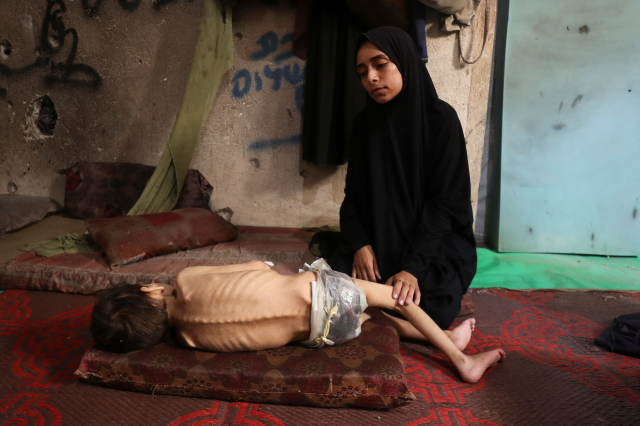 A Palestinian mother sits next to her malnourished son, at a school where they shelter amid a hunger crisis, in Gaza City, July 24, 2025. REUTERS/Mahmoud Issa |
The policy
Israel controls access into Gaza, including for humanitarian organisations, as a result of a blockade by land, air and sea that it imposed in 2007 after Hamas took power, citing security concerns.
Aid into Gaza has been restricted since the latest conflict began in October 2023, when a cross-border attack by Hamas killed some 1,200 people and took 250 hostage, according to Israeli authorities, prompting the Israeli offensive.
Israel has repeatedly said Hamas was stealing aid as a rationale for this restriction. Reuters reported that a U.S. government analysis in June found no systematic theft of food aid. Israeli military officials echoed those findings in late July, according to the New York Times.
This year, Israel halted aid for two-and-a-half months to pressure Hamas to release hostages. Since aid resumed in May, Israel said in late July it had let an average of 70 trucks a day into Gaza. The U.N. agency for Palestinian refugees, UNRWA, says between 500 to 600 trucks of aid are needed every day to prevent starvation among Gaza’s 2.1 million people.
The Gaza Humanitarian Foundation, a private aid group backed by the United States and Israel, took over aid distribution in May. The U.N has reported more than 1,000 people seeking food have been killed since May by Israeli forces near aid distribution sites.
After a group of 25 countries, including Britain, France and Canada, called Israel's denial of aid unacceptable, Israel announced daily pauses in military action with new aid corridors and permitted air drops in late July.
But humanitarian organisations say these drops provide a negligible amount of aid and are unlikely to reach those who need it the most.
A forensic accounting by the Guardian newspaper showed 104 days of air drops into Gaza over 21 months had supplied less than four days' worth of food. 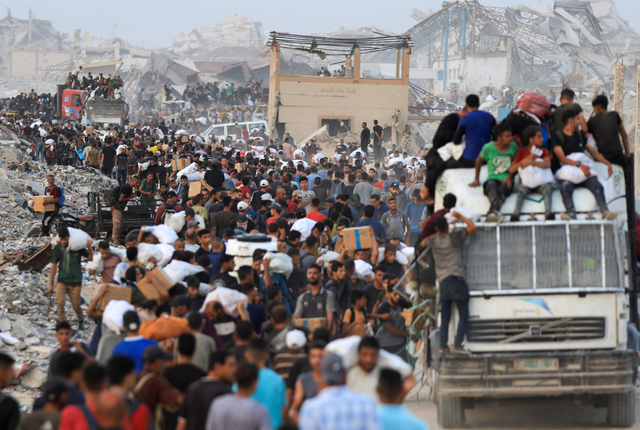 Palestinians carry aid supplies, that entered Gaza on trucks through Israel, in Beit Lahia, in the northern Gaza Strip July 29, 2025. REUTERS/Dawoud Abu Alkas |
The impact
Children and the elderly are most vulnerable to malnourishment, with “irreversible, life-long consequences for children, leading to severe health and development challenges,” according to UNICEF, the U.N. agency focused on children.
The “entirely preventable” malnutrition crisis has been worsening since spring, according to the WHO. The number of children requiring care has increased rapidly since July, while health facilities are on the brink of collapse.
More than 20,000 children were admitted to hospital with severe malnutrition between April and mid-July, according to the hunger monitor Integrated Food Security Phase Classification. It has said a famine is unfolding.
"Patients are not only asking for medical care, they are asking for food. There's no milk, no eggs, no proteins available for patients," a Médecins Sans Frontières (Doctors Without Borders, or MSF) trauma doctor told Context correspondent Joanna Gill in June.
According to the latest U.N. data, one-in-five children in Gaza are malnourished, while one-in-four patients aged between six months and five years, and breastfeeding women seen at MSF facilities in late July were malnourished.
The shortage of aid doesn’t just impact food, but also clean water and medical supplies needed for those who are malnourished. 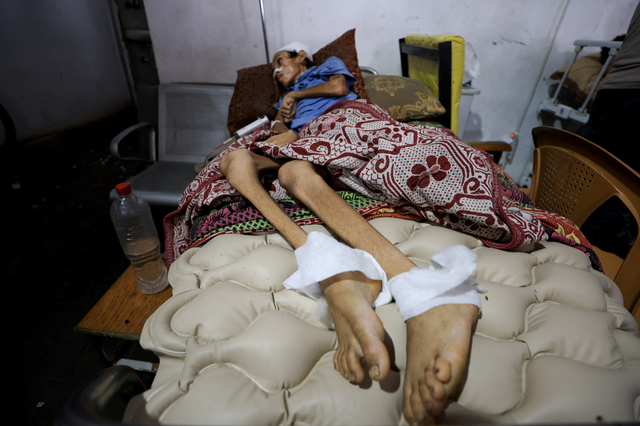 A malnourished Palestinian boy lies on a bed at Al-Shifa Hospital in Gaza City, July 22, 2025. REUTERS/Dawoud Abu Alkas |
Reuters reported last month that the supplies required for acutely malnourished children before they can start eating normal food are set to run out by mid-August, according to UNICEF. Malnourished children often suffer complications that require antibiotics — something else that the WHO says is running out.
If provided with the right care, acutely malnourished children can usually recover within eight to 10 weeks, experts say. For children under two who are malnourished during critical brain development, full recovery is harder to achieve and can have severe consequences for the rest of their lives.
MSF said in a statement it was admitting 25 new patients a day for malnutrition. In July, the Norwegian Refugee Council also said some of its staff were starving and accused Israel of paralysing its work.
The Israeli military aid coordination agency told Reuters in a statement that Israel does not restrict aid trucks entering Gaza, but international organisations face challenges in collecting the trucks on the Gaza side of border crossings. The agency said that during the last week, more than 23,000 tons of humanitarian aid in 1,200 trucks had entered Gaza, but hundreds of the trucks had yet to be driven to aid distribution hubs by U.N. and other international organisations.
The Hamas-run Gaza government media office said on Sunday that more than 600 aid trucks had arrived since Israel eased restrictions in late July. However, witnesses and Hamas sources said many of those trucks had been looted by desperate displaced people and armed gangs.
The latest update from the U.N. on Aug. 6 said “famine thresholds have been reached for food consumption in most of the Gaza Strip” and that lack of supplies to treat children under five amount to a “collapse in the malnutrition prevention programme.”
|
|
|
| | Creating jobs and opportunities for students and youth proves daunting amid Bangladesh's political transition | Every year, thousands of Ethiopians and Somalis brave smugglers and deserts to cross Yemen, hoping to find work in Saudi Arabia | Trump rhetoric, funding cuts have some worried about sea change in federal policy towards criminalisation | |
| |
| | | |
|