
How armed groups lure Colombian children via TikTok

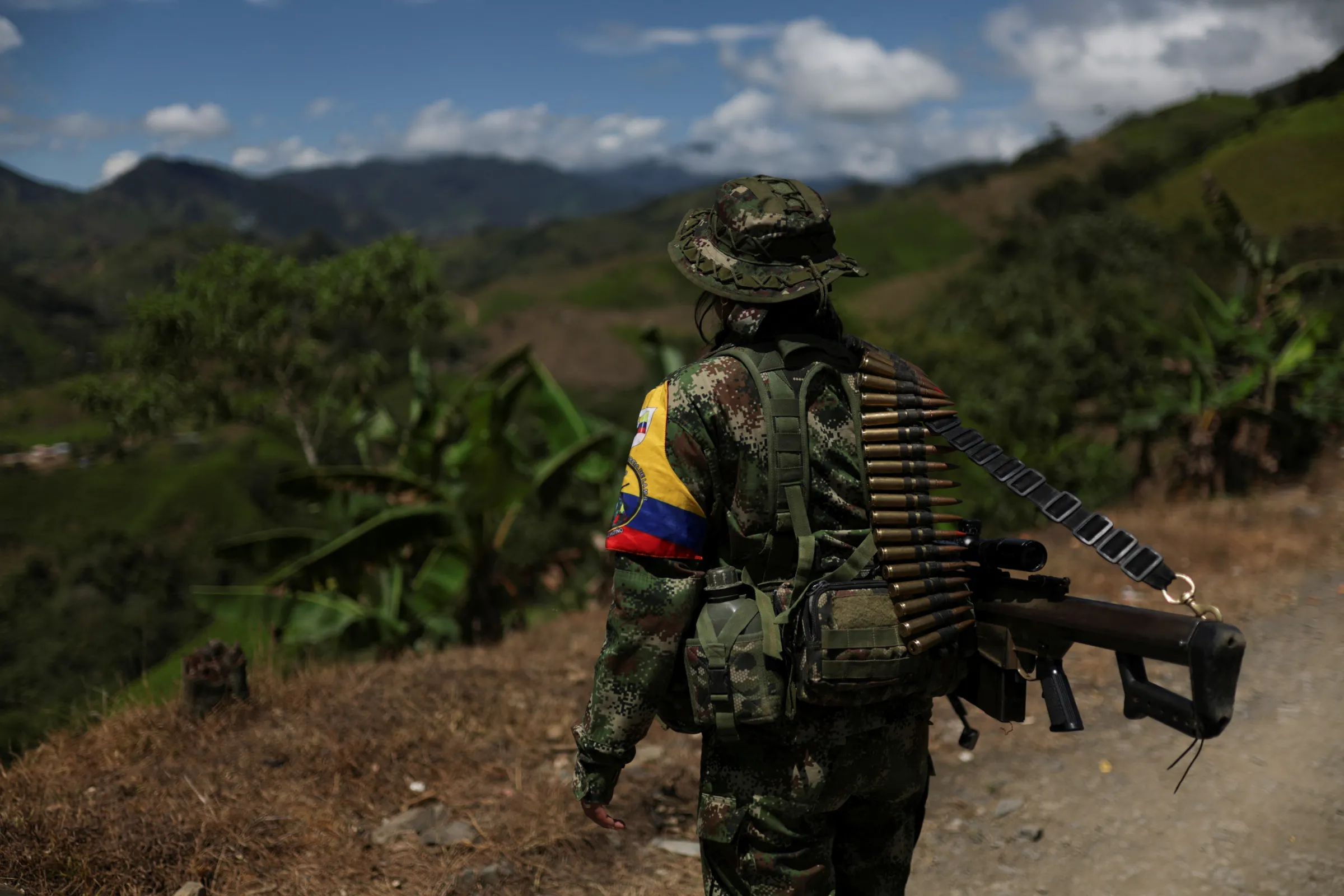
A guerrilla of Colombian rebel group Estado Mayor Central, Carlos Patino Front, a dissident of the former FARC guerrilla group, stands guard on a highway, in Canon del Micay, Colombia August 5, 2025. REUTERS/Luisa Gonzalez
What’s the context?
Colombia's armed groups promise 'the good life' to lure youth to their ranks as the recruitment of child fighters goes digital.
- Social media used to recruit child fighters
- Colombia sees increase in child combatants
- Posts on TikTok offer youth false promises
BOGOTA - Wads of cash, speedboats, booze and mobile phones are just some of the perks flaunted at young people on TikTok by illegal armed groups in Colombia looking to recruit fighters to their ranks.
Context identified more than 100 active TikTok accounts that appear to be run by members of groups that include the left-wing National Liberation Army (ELN) and dissidents of the Revolutionary Armed Forces of Colombia (FARC), as well as right-wing paramilitary groups like the Gaitanist Army of Colombia (EGC).
Photographs, selfies, livestreams and videos depict the purported daily lives of fighters, from parties to combat, jungle patrols and cocaine labs.
Colombia signed a landmark peace deal in 2016 with the FARC rebels, and leftist President Gustavo Petro was elected in 2022 on promises to bring "total peace" to Colombia and end a six-decade armed conflict that has killed more than 450,000 people.
But sporadic fighting continues in some rural areas between the army and splinter groups who reject the 2016 deal, and more than 70,000 people have been forced to flee their homes this year alone.
The Special Jurisdiction for Peace (JEP), a court created under the peace agreement to investigate and prosecute war crimes and crimes against humanity, warned in May "about the growing use of social media as a new way to attract and recruit minors into illegal armed groups."
The JEP report said TikTok is the platform most used "to spread content that normalises, romanticises and promotes armed life to teenagers and young people."
A boy or girl is recruited every 48 hours into an illegal armed group, with 1,494 children forced to join from 2016 to April 2025, the report said.
The Ombudsman's Office, which oversees human rights protections, said last year one FARC faction posted images of children with uniforms and long-range weapons on Facebook and TikTok.
"There is evidence to suggest that these digital platforms are being exploited by the illegal armed group to make contact with children and adolescents for recruitment purposes," the office's alert said.
'For you'
Context found that TikTok's algorithm opens a door to war-related content by filling the personalized "For You" feed with videos posted by armed groups after a user watches two or three such clips.
Some of the posts have comments such as "How do I join, help me," "I want to be a guerrilla fighter" and "I have people for you."
In response, users are asked to send a direct message on TikTok.
When Context sought more information about recruitment, the accounts asked for a personal WhatsApp number to provide details.
To evade TikTok filters and algorithms that block groups' acronyms, like FARC, the groups rely on stickers and emojis.
The EGC, also called the Gulf Clan, uses the Nigerian flag and green acronyms, while the ELN uses a red-black heart or the Angolan flag. Other symbols include the Armenian flag and a ninja.
A TikTok spokesperson for Latin America said the platform lacked proof it was being used to appeal to minors.
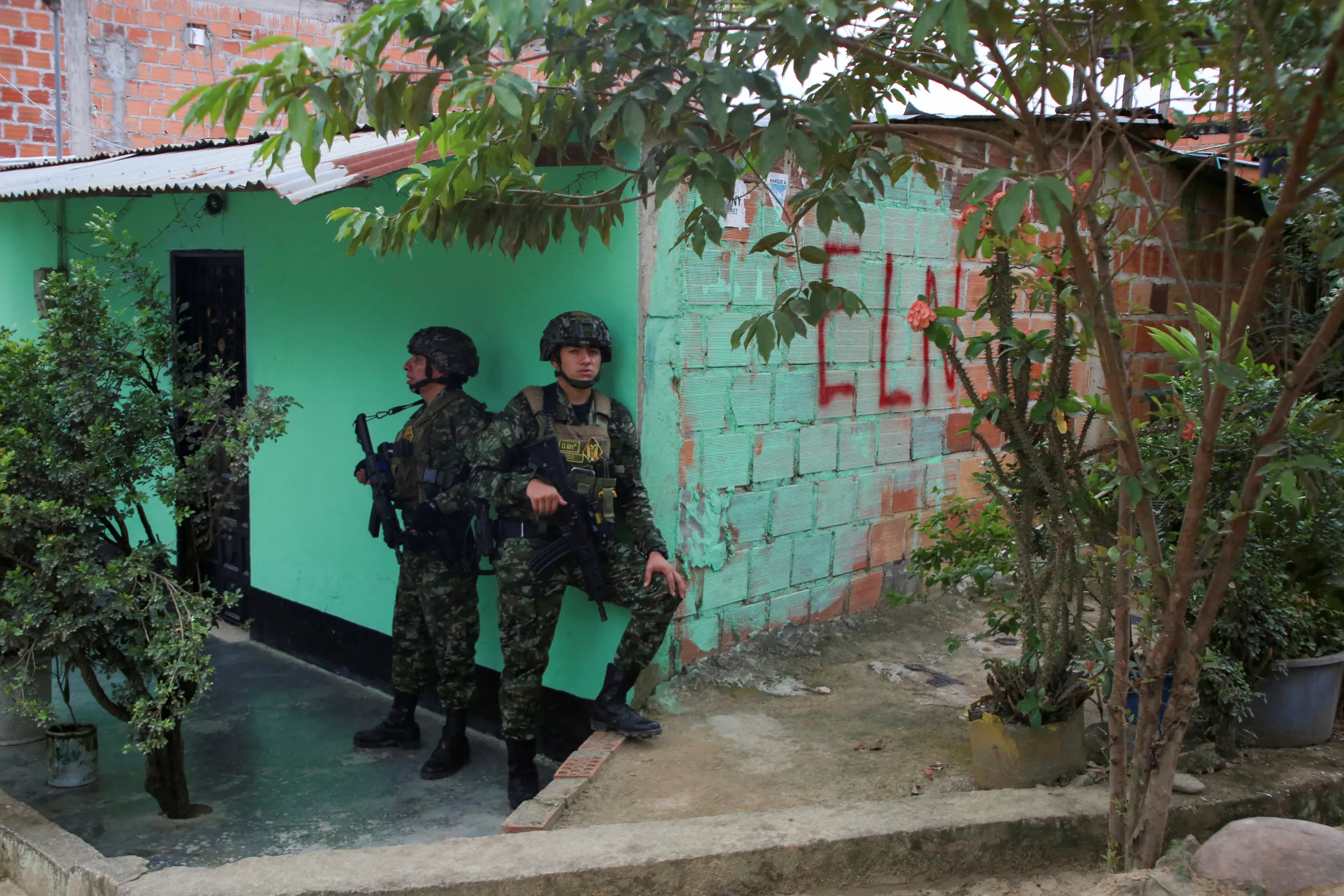
Colombian soldiers stand guard after attacks by rebels from the leftist National Liberation Army (ELN), in the municipality of El Tarra, Colombia February 4, 2025. REUTERS/Carlos Eduardo Ramirez
Colombian soldiers stand guard after attacks by rebels from the leftist National Liberation Army (ELN), in the municipality of El Tarra, Colombia February 4, 2025. REUTERS/Carlos Eduardo Ramirez
"We have no evidence that the videos are targeted at minors ... and we have consulted with experts who maintain that it is difficult to confirm that the comments are from minors," the spokesperson, who asked not to be named, said a phone interview.
"TikTok moderates this content using artificial intelligence and human oversight to remove graphic content. Our teams are constantly collaborating with the authorities and NGOs to stay as up to date as possible," the spokesperson said.
This includes removing accounts that appear to be set up by illegal groups, while TikTok does not disclose other strategies to avoid alerting the groups, the spokesperson said.
At the time of publication, 30 of the 100 or so accounts identified by Context in November had been deleted by TikTok.
Rising child recruitment
Guerrilla and paramilitary groups in Colombia have recruited children for decades, according to the government and the United Nations.
Children as young as 12 are "being sent to front lines of combat," a 2023 report by think tank International Crisis Group said.
Child soldier recruitment in Colombia surged fourfold to 453 documented cases last year, compared with 107 in 2019, according to a report by the U.N. Secretary General.
Cauca province, a hub of drug trafficking and violence, has the "highest probability of cyber-recruitment" of children and youth, the JEP report said.
"For several years now, one of the ways armed groups have been able to reach large numbers of children in particular regions quickly is through social media," said Julien Hayois, child protection specialist at the U.N. children agency UNICEF in Colombia.
False promises
Colonel Jose Garzón, coordinator of the Humanitarian Assistance Group for Demobilised Children at the Defence Ministry, said children are often offered jobs like guarding a remote farm.
If children later ask to visit family, recruiters make it clear they are not free to leave, Garzón said.
Armed groups offer combatants monthly pay of 2 million Colombian pesos ($525) or more, which is above the minimum wage, although young fighters may receive 700,000 pesos ($185) or less, according to Garzón.
"On social media, they offer them the false expectation of the good life," Garzón said, luring young people "with material goods ... and the company of women."
People wearing military-type uniforms who allegedly belong to the EGC or ELN appear on TikTok to chat about combatant life as a way out of poverty and an opportunity for adventure and status.
Some of the videos, which may be set to popular Colombian folk music and Mexican drug ballads, or "narcocorridos," are viewed as many as 20,000 times.
"There's an evident narrative of 'the struggle' that's repeated," said Alejandro Moreno of Circuito, a social media and democracy initiative.
"This image portrays the guerrilla fighter as a hero, who lives a difficult life and gets ahead. This narrative coexists with that of easy money, where videos show cash and luxuries," he said.
(Editing by Anastasia Moloney and Ayla Jean Yackley.)
Context is powered by the Thomson Reuters Foundation Newsroom.
Our Standards: Thomson Reuters Trust Principles
Tags
- Disinformation and misinformation
- Polarisation
- TikTok
- Tech regulation