Our monetary system perpetuates a cycle where financial growth is prioritised over societal needs.


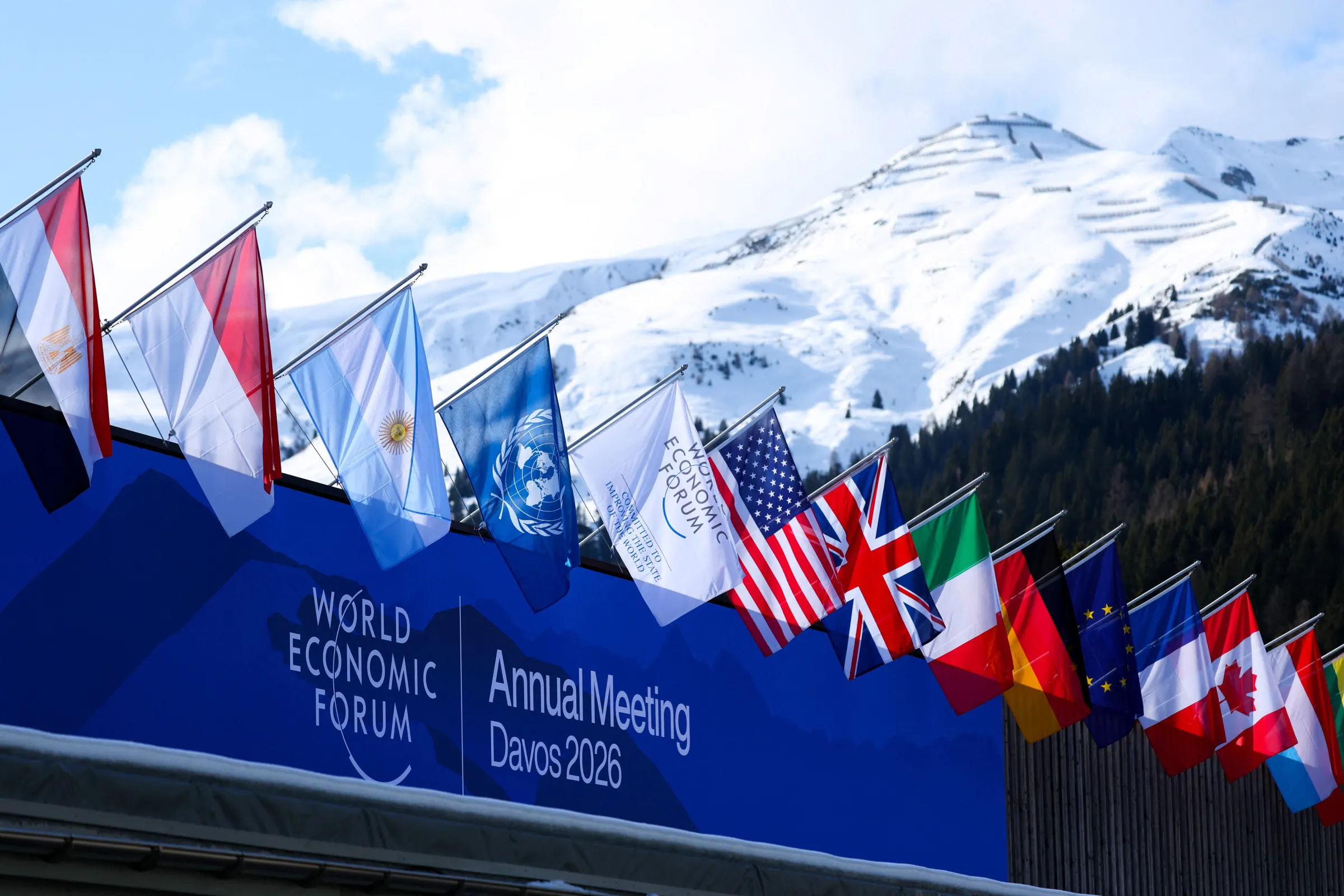
Flags flutter during the 56th annual World Economic Forum (WEF) meeting, in Davos, Switzerland, January 19, 2026. REUTERS/Denis Balibouse
As world leaders meet in Davos, it's time to imagine a currency that coexists with dollars or euros in the form of impact credits.
Daniel Nowack is Head of Social Innovation at the Schwab Foundation for Social Entrepreneurship and World Economic Forum.
Money has done so much for humanity, enabling the creation of our highly complex societies and bringing legions of people out of poverty.
But the limits of our current economic system are becoming increasingly clear. As global leaders meet in Davos, Switzerland for the World Economic Forum’s annual meeting, is it time to imagine new possibilities for our monetary system?
A fundamental challenge facing our economic system is the growing incompatibility between the pursuit of endless economic growth and the planet’s finite ecological limits.
At the heart lies the money creation process behind fiat currency.
Today, around 97% of money is generated through bank loans with interest. This mechanism drives capital toward profitable assets like real estate and stocks, while social infrastructure, like healthcare, education and climate resilience, receives little investment.
Our monetary system perpetuates a cycle where financial growth is prioritised over societal needs. To reconcile economic activity with planetary limits, we must rethink what is valued and how money is created and directed.
Meanwhile, artificial intelligence is decoupling corporate profits from job creation. With chatbots and robots automating tasks, companies can grow without hiring. And we’re only at the start of this revolution. How do we ensure people aren’t left behind?
Our monetary system perpetuates a cycle where financial growth is prioritised over societal needs.
One way to overcome these challenges is to upgrade our economic system so that it recognises other kinds of human value creation, rather than just financial gain.
This means connecting measurable environmental and social outcomes with financial value.
Imagine a currency that coexists with dollars or euros in the form of ‘impact credits’ and is issued by the central bank.
A daycare centre may take out an impact credit loan and later repay it not in dollars but in verified social impact. Its employees could earn dollars and impact credits for societal value, paying their bills in both fiat and impact currency and circulating these credits further.
Such a currency would redefine prosperity and allow positive impacts to be recognised and rewarded at scale.
Nature and people would be seen as assets, not commodities. Investing in planet and society would no longer rely on philanthropy or goodwill. It would be embedded in our financial systems.
A recent whitepaper by the Schwab Foundation outlines mechanisms for issuance, impact measurement, governance and supply management of such a currency.
Practically, there are two ways to initiate this approach. First, we could test the proposition by setting up regional or thematic impact credit pilot projects that target specific geographies or sectors, building on the existing $185 billion market for outcome-based finance.
To accelerate outcomes, such a pilot could run as a partnership with a pre-existing project – like UNICEF’s Giga Initiative, which leverages connectivity credits to connect every school worldwide to the internet – and benefit from its networks, measurement systems and stakeholder relationships.
South Korea offers another example.
Imagine a currency that coexists with dollars or euros in the form of ‘impact credits’.
SK Group’s Happy Narae integrates social suppliers into its value chain, procuring $148 million from social enterprises since 2015. Its Social Progress Credits (SPC) programme has rewarded social enterprises over $50 million for verified social outcomes.
Recently, South Korea’s national procurement platform began displaying SPC values next to prices, enabling buyers to consider both cost and impact.
This route would provide governments with an opportunity to test policies that incentivise impact credit adoption. Regulators could experiment with procurement rules, tax incentives and fiscal measures to stimulate demand. Communities could ensure they are at the heart of defining impact priorities and assessment.
Alternatively, impact credits could be trialled through integration into existing carbon markets, where credits from projects removing greenhouse gas emissions are bought and sold.
Many carbon credits already have social co-benefits embedded within them, but such benefits could be expanded or made mandatory to create a prototype for an impact-based currency.
Both approaches could help bring impact credits to market by demonstrating proof of concept while building confidence and understanding.
With these proof points, impact credits can be adopted into monetary policy in geographically limited areas before being scaled.
Such a system would require communities at the centre of design, new market infrastructure and harmonised impact metrics – with robust, third-party verification to ensure reported impacts are real, long-term and additional.
Critics argue social impacts are hard to quantify.
Yet frameworks like Impact Genome, Common Good Marketplace or SK Group’s Social Progress Credits already exist with approaches to standardising measurements. Some create unified metrics while maintaining contextual diversity.
Today, many mechanisms are top-down. A truly equitable solution needs a globally accepted framework but must allow communities to prioritise which impacts matter most.
In an age of climate change and rapid AI innovation, our monetary system must evolve.
Now is the time to rethink capitalism so the economy works for people and planet, not the other way around.
We need to change our economic system, starting with money creation, so financial flows support socially and environmentally beneficial initiatives.
As leaders gather in Davos, impact currencies may unlock a new era of meaningful growth by valuing what matters most - human connection and planetary health.
Any views expressed in this opinion piece are those of the author and not of Context or the Thomson Reuters Foundation.