
US communities push back against encroaching e-commerce warehouses

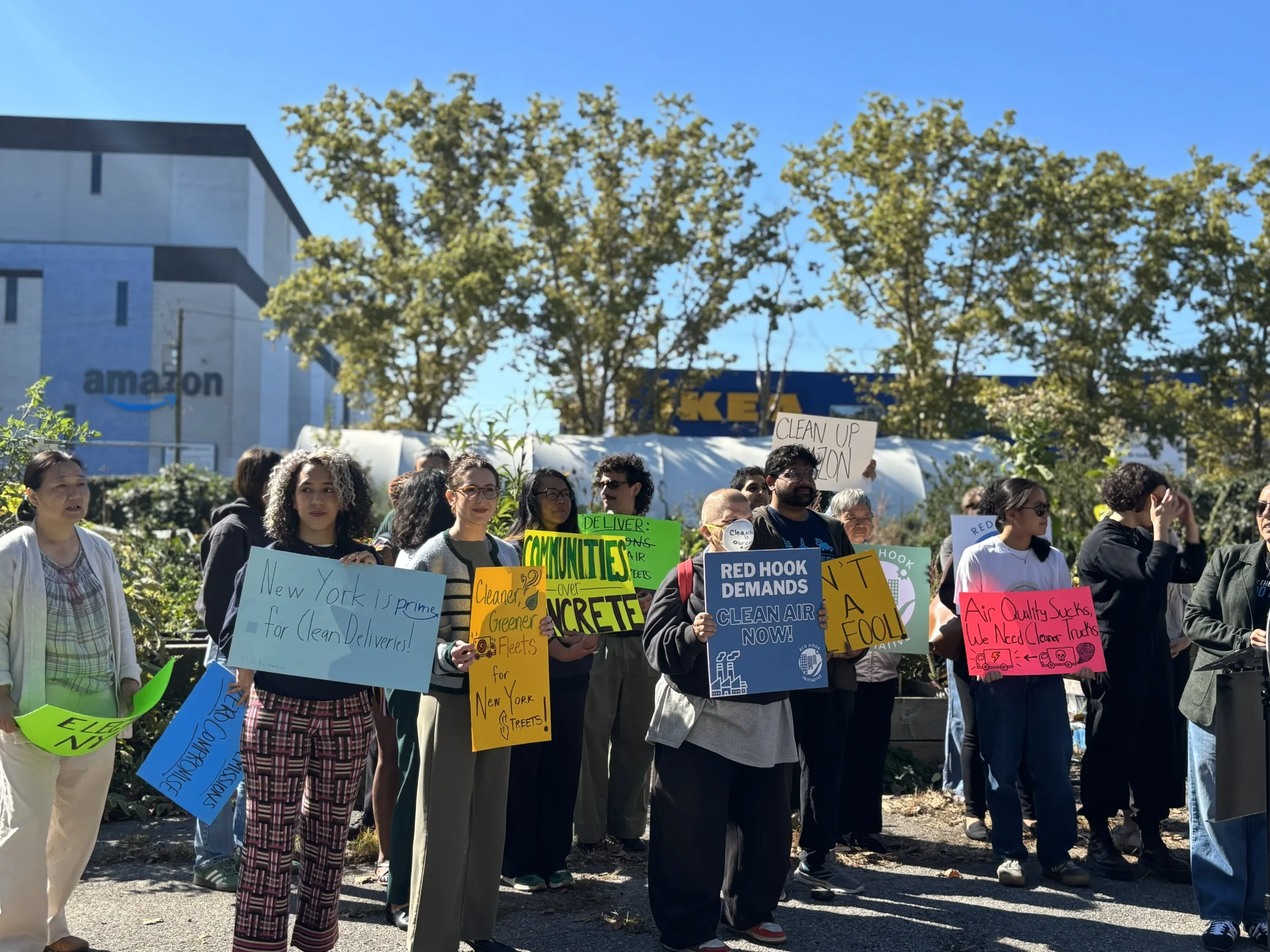
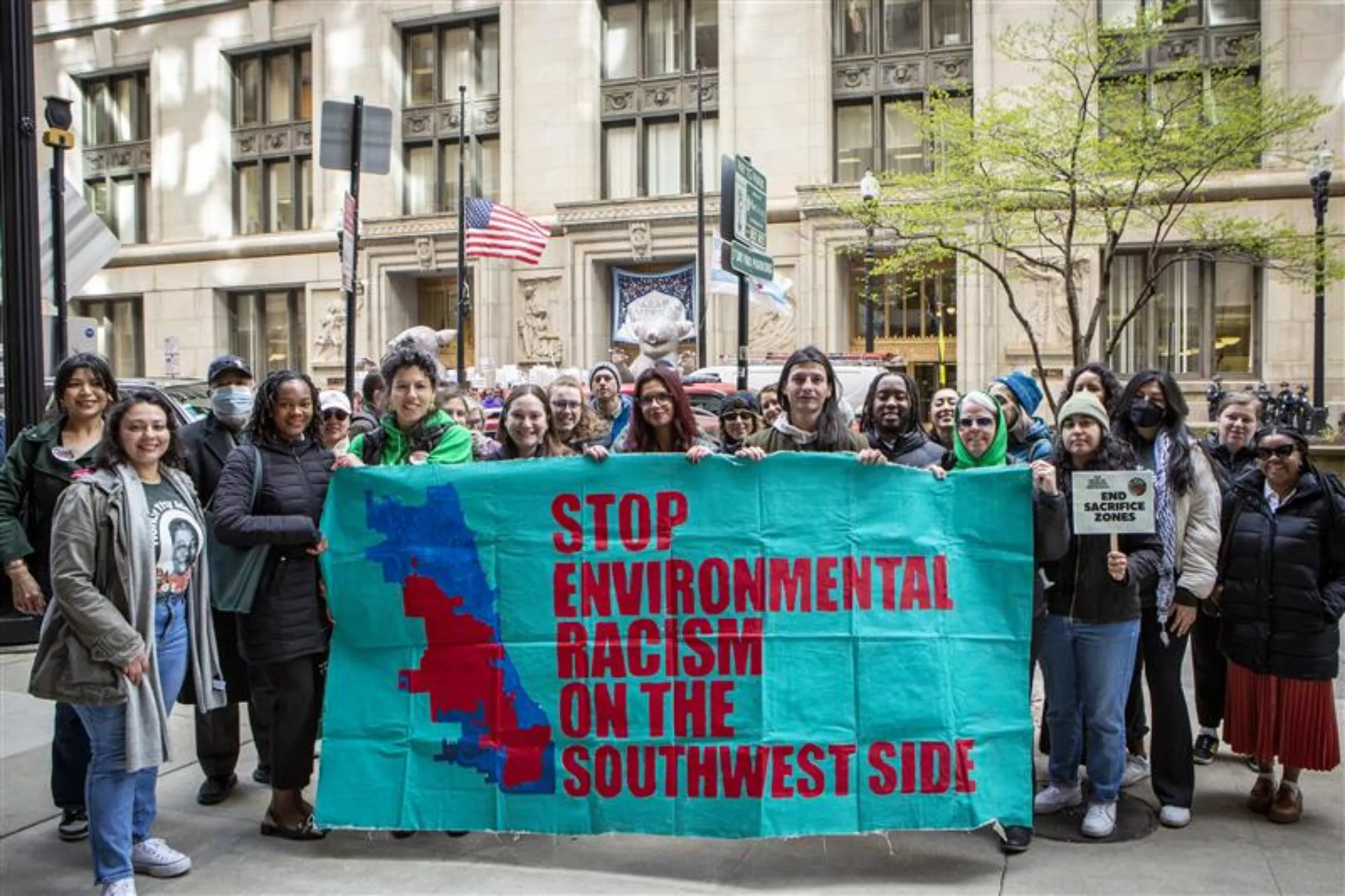
Demonstrators take part in a rally against e-commerce warehouses in Brooklyn, New York, on October 1, 2025. Maddy Jenkins/Handout via Thomson Reuters Foundation
What’s the context?
More online shopping means more warehouses and trucks in populated areas, but US communities are battling to cut the pollution.
- Warehouse construction boomed during pandemic
- 'Indirect source rules' gain renewed interest
- ISRs are way to address local pollution
WASHINGTON - Born and raised in New York City's Red Hook neighbourhood, Maddy Jenkins says she cannot remember seeing the volume of trucks now plying the streets.
"Since the pandemic, everyone started ordering more," she said, referring to the boom in online shopping. "That's when we started to see more trucks come in, and when these warehouses started to go up."
There are now a half-dozen e-commerce warehouses in the densely populated neighbourhoods of Red Hook alone, Jenkins said, including right across streets from schools and parks.
"These warehouses went up with no consultation of residents ... They just went up overnight," said Jenkins, communications manager for Red Hook Initiative, a local nonprofit.
An Amazon spokesperson said the company was working on a multi-year plan to roll out 100,000 electric delivery vehicles, and in 2024 started testing a new model of e-bikes in Brooklyn.
Transport companies FedEx and UPS did not respond to requests for comment.
Similar trends are being seen in other cities, as companies that deliver the goods people increasingly buy online expand their hubs closer to, or even amidst, populated areas.
That is leading officials in New York city and state, as well as multiple other states, to look to an esoteric regulatory mechanism known as an "indirect source rule" to address resident concerns, particularly about pollution.
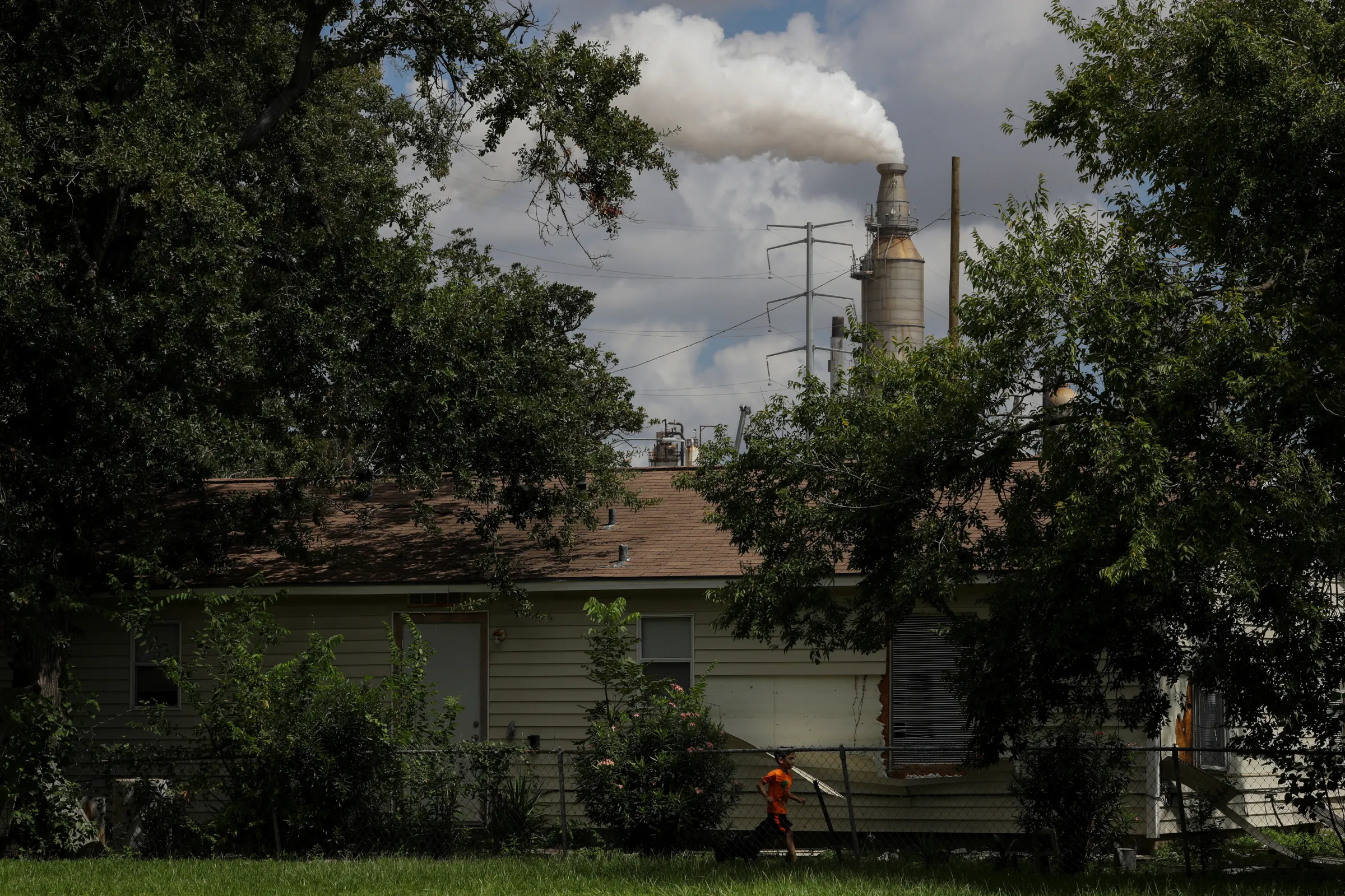
Such rules, or ISRs, have been used in only a few situations but offer a potent way of addressing very localized "pollution hot spots", said Sam Becker, a project manager with Environmental Defense Fund, a research and advocacy group.
That is particularly compelling as the federal government under President Donald Trump weakens federal environmental regulations that seek to address how low-income areas often bear the brunt of pollution and rolls back clean-vehicle standards.
"It allows jurisdictions, whether states, air quality districts, counties or cities, to achieve local air pollution reductions from facilities that create large amounts of traffic, like warehouses," Becker said.
California roots
Revenue from e-commerce in the United States roughly doubled in the last half-decade, an Environmental Defense Fund report found last year.
In a 10-state sample, it estimated that 15 million people now live within a half mile of a large warehouse, with minority communities bearing the brunt of related public health risks, such as from increased air pollution.
In New York, new e-commerce warehouses have prompted around 260,000 diesel truck trips every day, the report found.
Yet as resident concerns mount, local policymakers have realized their hands were tied in how to respond.
While authorities could regulate an entity like a warehouse, the law offers few ways to address indirectly linked pollution sources such as delivery trucks.
Similar concerns have grown around ports, railroad hubs or airports.
In 2021, a warehouse-specific ISR was created in the Los Angeles area, aiming to reduce air pollution in the area by 15%.
It is now the foundation of regulations being introduced or drafted in New York, New Jersey, Illinois, California and elsewhere.
According to Brennon Mendez, an environmental law fellow at UCLA School of Law, ISRs "have been possible for quite a long time, but remain underutilized by many air districts in California and beyond."
That has meant regulators are fighting air pollution "with one hand tied behind their back," he said, particularly with regard to what he called "pollution magnets", such as the long lines of large trucks lined up to service ports.
"A lot of people are looking to what we can do at the state and local level to pursue pro-environmental causes despite the federal government's anti-environment agenda," he said.
"So, it's important to communicate that ... the state of the law is 100% on the side of ISRs."
California truckers have pushed back on the rules, warning of high compliance costs and pointing to emissions reductions already achieved in warehouse operations.
In November, regulators approved an agreement with ports in two major California cities to develop plans for zero-emission infrastructure at their facilities.
The rules are also guiding new investments in cleaner vehicles.
From 2021 to 2023, warehouses covered by the new rule saw the use of electric truck charges increase more than 20-fold, and their solar power use grow from 3 gigawatts to 85 gigawatts, said Sam Wilson, a senior analyst with the Union of Concerned Scientists.
As the Trump administration moves to end electric-vehicle programs, ISRs offer a major opportunity to continue to decarbonize the nation's freight network, which remains highly truck-dependent, he said.
"It's the seed that is planted that can influence wider electrification."
New York's next wave
Inspired by communities such as Red Hook, New York is now leading a wave of possible ISR expansions, with proposals being discussed at the city and state level.
"The Trump Administration has made it a priority to slash key environmental protections, with a particular eye towards weakening standards for vehicle emissions," New York State Assembly member Marcela Mitaynes said in an email.
"These weakening standards come at a time when we see a boom in last-mile warehouses in New York City, placing the health and well-being of all New Yorkers at risk," she wrote.
Nearly two in five residents of New York City live within a half mile of a warehouse, with a disproportionate number being low-income, Black or Hispanic, she said.
Mitaynes is sponsoring the state Clean Deliveries Act, which seeks to require that warehouse operators reduce associated air pollution.
Local warehouse zoning regulations date to the 1960s, when policymakers would have been thinking more about bakeries with just a handful of trucks coming each day, said
Kevin Garcia, a senior transportation planner with NYC Environmental Justice Alliance, a nonprofit.
That meant that in the pandemic boom, developers were able to construct new e-commerce warehouses with few reviews.
"Communities were just waking up to these new warehouses," Garcia said.
In October, Mitaynes and others launched an effort to boost public backing for the Clean Deliveries Act, which Garcia hopes will pass next year and does not require federal approval.
"The state can enact one today, so this is something the state can take bold action on," Garcia said.
(Reporting by Carey L. Biron; Editing by Anastasia Moloney and Jon Hemming.)
Context is powered by the Thomson Reuters Foundation Newsroom.
Our Standards: Thomson Reuters Trust Principles