
- Parliament has same-sex civil partnership bill
- Court allows for same-sex unions, but legal process is slow
- First recognised couple faced abuse online
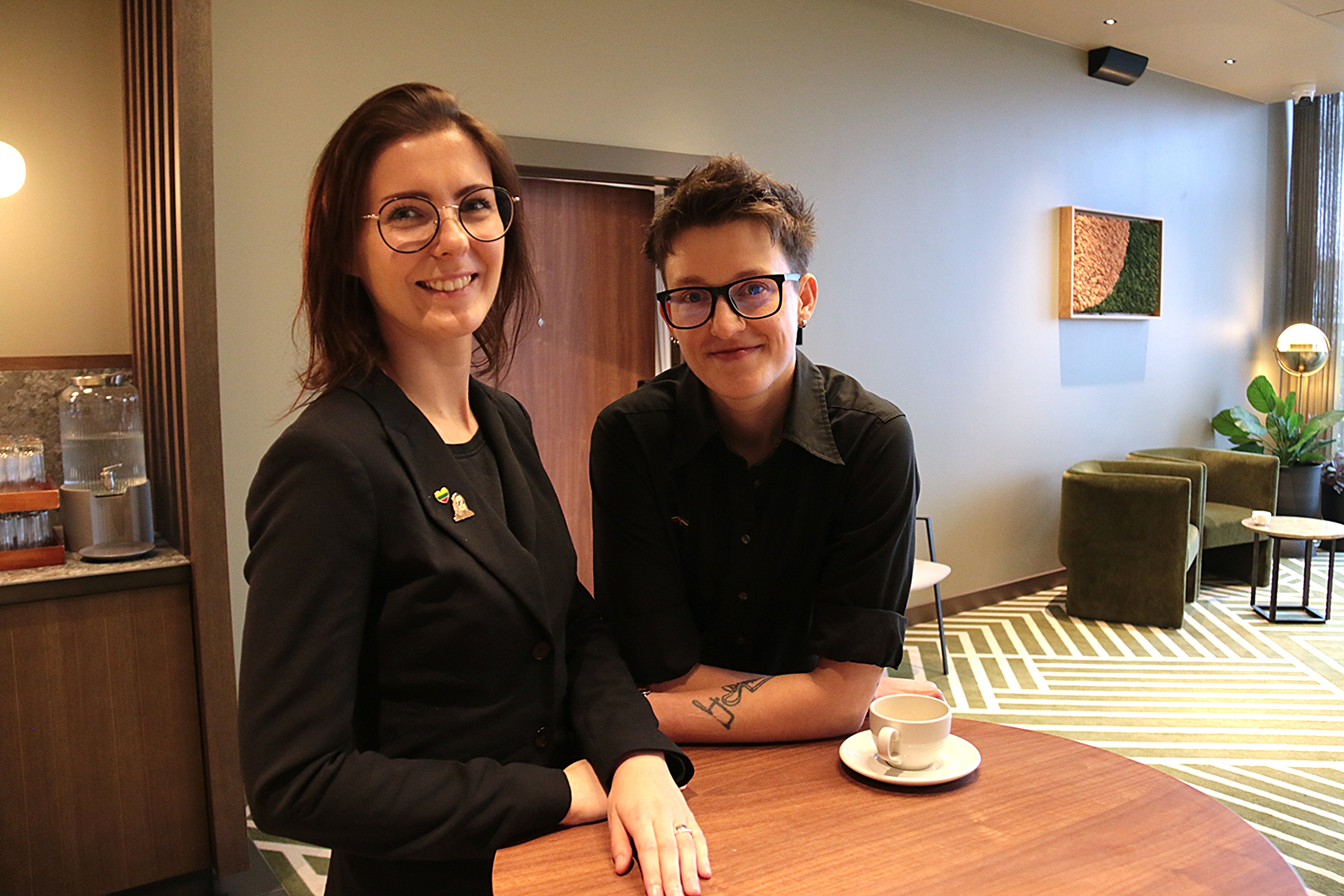
VILNIUS – When Karolina and Eglė exchanged rings in a ceremony in the neoclassical town hall in Lithuania’s capital Vilnius in September, it was a moment they had dreamt about for more than a decade.
The couple became engaged two years into their 13-year relationship, but it wasn’t until August 8 this year that their union was legally recognised, making them the first same-sex civil partnership in the Baltic nation and clearing the way for their September ceremony.
“We were so overwhelmed when we received the news we started crying in the car,” Eglė, 30, told Context.
Lithuania’s Constitutional Court ruled in April that limiting partnerships to only a man and a woman in the nation’s civil code violated the constitution, opening the door to same-sex recognition.
But while the move has been hailed as a victory for LGBTQ+ rights, no law has yet been passed to officially regulate the process, causing delays and confusion.
Karolina and Eglė, who did not want to provide their last names, were initially refused the right to wed by Vilnius’ Civil Registry Office because there was no process in place.
They had to file an application for recognition to Vilnius City District Court in May, starting a lengthy and expensive process.
Since the couple’s ceremony, there has been some movement towards passing a law.
In November, a partnership bill allowing two people of any gender to form a union was submitted to parliament by a cross-party group of lawmakers.
But with Lithuania’s ruling coalition and the opposition both divided over the proposal, its wording and overall fate are uncertain, activists say.
Monika Antanaitytė, a legal expert with the Lithuanian Gay League, said the whole process around civil partnerships needed to be clarified by legislators, but she deemed the April ruling significant nonetheless.
“It is a definite step forward in terms of normalising our identities, which is very important and long overdue,” Antanaitytė said.
“Toxic” political issue
Lithuania, which joined the European Union in 2004, ranks low — 36th out of 49 European countries — for LGBTQ+ rights, according to advocacy group ILGA Europe.
The country lagged behind its Baltic neighbours in recognising same-sex couples, with Estonia passing a law on partnerships in 2014 and Latvia in 2023. Estonia also legalised same-sex marriage in 2023.
In 2021, Lithuania’s parliament voted against debating a bill on civil partnerships, following a poll commissioned by the president’s office that showed 70% of Lithuanians were against such unions.
Lawmaker Tomas Tomilinas was expelled from the Lithuanian Farmers and Greens Union after he voting in favour of the 2021 bill. He said LGBTQ+ rights has become a “toxic” issue.
“(It is) one of the main dividing issues used in mainstream politics. The level of cultural war that has been happening in Lithuania for the last five years has been terrible,” Tomilinas said.
“This is also the global trend. We don’t have parties that are against democracy, or the European Union – we are very united in many topics – so there must be a thing that will work as an enemy.”
Karolina, 32, and Eglė initially planned to stay anonymous, providing neither their names nor photographs publicly.
They decided to go public after seeing their story criticised by strangers who questioned the validity of their relationship. But they do not provide their surnames for use in the media.
The couple have faced “degrading” abuse online and have had to involve the police after receiving threats.
“It is mentally taxing. One of the things that really keeps us going is that we know that the next couples to have their unions legalised won’t have to deal with this,” Eglė said.
“Every time I feel upset, I think about the more than 30 couples already waiting to start their own process. It motivates us in a way.”

“Gay tax”
The proposed partnership bill would grant same-sex couples rights in joint property ownership, inheritance and legal representation but does not address areas of marriage like taxation, residence or citizenship rights.
Same-sex couples will not be allowed to adopt children.
If passed, the main provisions would take effect in January 2027, with the nation’s official registry system due to be updated to accommodate such relationships by 2028.
This would mean couples would not need to undergo the legal travails Karolina and Eglė faced, which they said were costly.
“It’s like a gay tax. It is a little bit ridiculous when … a civil union for a husband and a wife costs about 60 euros ($69.98),” Eglė said.
Karolina asked: “Are we supposed to buy our rights?” .
The couple, who were supported through the legal process by the human rights organisation Tolerant Youth Association, started seeking ways to make their relationship legal after buying a home together and encountering complications.
The day their union was recognised “liberating,” Karolina said.
“We started to feel safe in our own country and like we might have the same equal rights as everybody else.”
Anti-LGBTQ+ laws on the rise
In Europe, several countries including Hungary, Bulgaria, and Georgia have enacted LGBTQ+ censorship laws since 2021, banning the so-called promotion of such topics in schools or the media.
Lithuania scrapped its 15-year anti-LGBTQ+ propaganda law, which prohibited the depiction of same-sex couples in the public sphere, in December 2024 after the Constitutional Court declared it unconstitutional.
In October, incoming Prime Minister Inga Ruginienė met with LGBTQ+ activists to discuss plans for legalising same-sex partnerships. https://www.lgl.lt/en/?p=32634
Members of multiple organisations who attended the meeting said Ruginienė expressed support for a civil partnership bill.
Ruginienė’s office did not respond to requests for comment.
“Lithuania is going forward in big strides, but we still need time. These laws take time,” Karolina said.
“Unfortunately we have to wait and [keep fighting] for our future.”
($1 = 0.8573 euros)
(Reporting by Lucy Middleton; Editing by Ellen Wulfhorst.)