


Critical mineral bauxite boom pollutes water and crops in Guinea


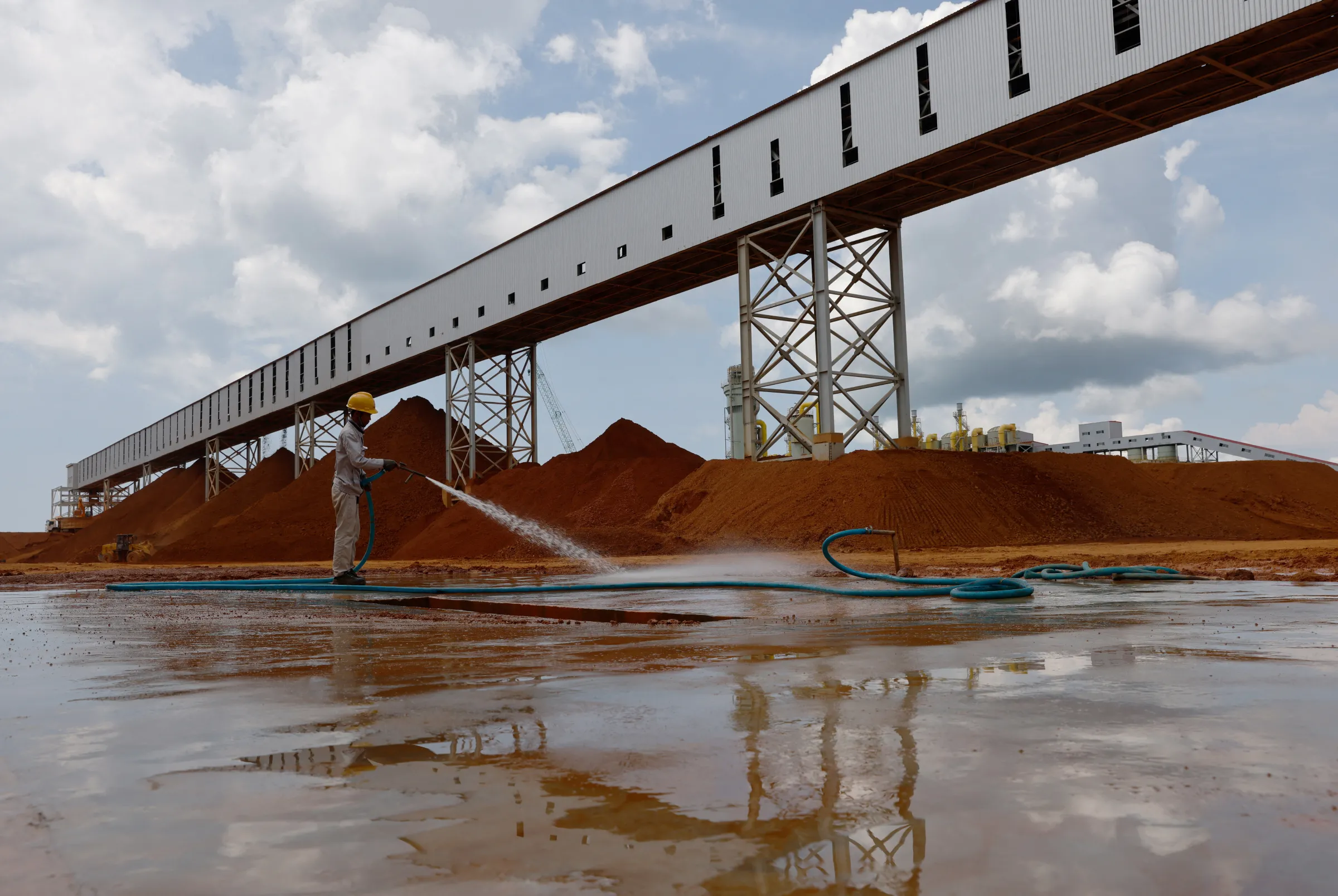
Mounds of bauxite are stored at Shandong Nanshan Aluminium's integrated aluminium plant in Bintan, Indonesia May 5, 2023. REUTERS/Edgar Su
What’s the context?
In West Africa's Guinea, villagers say mining for the critical mineral bauxite has polluted water and decreased crop yields.
- Guinea has world's largest reserves of bauxite
- Villagers living near mine report air, water pollution
- Farmers say yields are lower and they are losing out
BEMBOU SILATY, Guinea - Tala Oury Sow has to wash her kitchen utensils and clothes in brown, murky water in the village of Koussadji in Guinea's western Kindia region.
"Do you think we can cook and wash with this? We have no other choice," the 28-year-old farmer said, gesturing to the water she collected from a nearby river, 500 metres (550 yards) from her home in the Télimélé prefecture of the West African nation.
Sow blames the state of the water on the Indian mining company Ashapura Minechem, which opened a bauxite mine about 2 km from Koussadji in 2019.
Bauxite, the raw material in aluminium, is in high global demand because it plays a key role in enabling the clean energy transition, and Guinea holds the world's largest reserves.
But the people of Koussadji and nearby villages say they are not benefitting from the bauxite boom, but instead suffer from the environmental consequences of large-scale mining, including water and air pollution.
Their complaints resonate across Africa, where many governments and activists are pushing for more domestic control - and economic benefits - of the critical minerals vital for the energy transition away from polluting fossil fuels.
Aluminium is used in solar panels, wind turbines and electric vehicles, as well as energy-efficient appliances and insulation materials in greener buildings.
"Look at this water, look at the gift they've given us. With this water, do you think life is possible?" said Sow, who grows rice, cassava, groundnut and cashews and blamed her falling crop yields on pollution.
Ashapura did not respond to three emails requesting comment on the villagers' allegations of pollution.
The company did build a borehole in the nearby village of Bembou Silaty a year ago, but the water does not cover people's needs, according to Souleymane Bah, a teacher from the village.
Ashapura has also faced allegations of environmental pollution in India.
In Bembou Silaty, Tokpa Fehand, a nurse working at the Poste de Santé health centre, said the village is adversely affected by mining activity, both in the dry and wet seasons.
"There are respiratory illnesses from the dust, the village is surrounded by the mine, and the machinery hardly ever stops working," he said.
A 2023 community audit of the environmental and social impacts of mining in the nearby region of Boké linked bauxite mining to water pollution, a drop in agricultural productivity and a rise in air pollution.
Oumar Totiya Barry, executive director of the independent Guinean Observatory for Mines and Metals, said the problems experienced in Bembou Silaty were typical.
"Bauxite waste contains heavy metals and acid; in cases of pollution, it is sedimentation linked to drainage during the rainy season," he said.
Just transition?
Guinea exports some 3.7 million tons of bauxite per week and produced about 146 million tons last year.
The country ships most of its exported bauxite to China.
The military-led government, which took power in a 2021 coup, is pushing foreign mining companies to add more value to bauxite before shipping the ore overseas for processing.
As part of this drive, it has revoked licences and pressed mining companies to build alumina refineries, joining countries from gold producer Mali to oil-rich Nigeria that are looking to boost domestic refining capacity in recent years.
Despite a push by several African countries at last month's COP30 U.N. climate talks, the issue of a just transition for communities in resource-rich countries was not addressed in the final text.
China and Russia, among others, opposed any explicit reference to the minerals, participants said.
"Talk of a just transition rings hollow so long as governments ignore the minerals required by the energy systems of the future," said Antonio Hill, an advisor at the policy organisation Natural Resource Governance Institute.
"By looking the other way, governments are feeding delay, forfeiting leadership and forsaking the chance to anchor equity and justice at the heart of the global energy transition," he said in a statement after the talks.
In the meantime, Guinea is taking unilateral action.
Mamady Doumbouya, the general who led the coup and is running for president in an election on Dec. 28, has acted to force companies to add value to bauxite in Guinea.
Mines Minister Bouna Sylla said in November the country would fast-track the development of alumina refineries and iron ore pellet plants to end decades of raw ore exports.
New approach
Bauxite mines, which involve surface level or "strip" mining, can contaminate rivers and streams by removing vegetation and facilitating erosion, Human Rights Watch said in a 2021 report on aluminium production and mining that also referenced Guinea.
Barry said the noxious consequences of mining is a factor driving young Guineans to migrate, many opting for risky boat journeys to Spain's Canary Islands.
"(Guinea is) rich in resources, but has not managed to turn them into national wealth, rather into a tool used to consolidate state power," he said, adding that mining revenues are used to pay policemen, soldiers and civil servants.
He said legislation is needed to guarantee Guinean citizens a decent standard of living.
The employment benefits are limited too, as many young people do not have the training needed to secure permanent jobs.
The women of Allawalli, a farmers' association in Bembou Silaty and Koussadji, said pollution from the nearby mines has decreased food production.
Rice production in Télimélé plunged by 90% between 2018 and 2022, according to data from Guinea's national institute of statistics.
Binta Boye, 35, grows rice, groundnuts and cassava in Bembou Silaty and is a member of Allawalli.
"What I produced before was enough to feed my family. Now it's not enough anymore. We're in God's hands, if we want this to change," she said.
(Reporting by Jaume Portell Caño; Editing by Clar Ni Chonghaile and Jon Hemming.)
Context is powered by the Thomson Reuters Foundation Newsroom.
Our Standards: Thomson Reuters Trust Principles
Tags
- Climate inequality
- Economic inclusion
- Underground economies
- Corporate responsibility
- Water


Featured

Go Deeper
Latest on Context
- 1
- 2
- 3
- 4
- 5
- 6