
US abortion policy under Trump 2.0 one year on

Explainer
Explainer
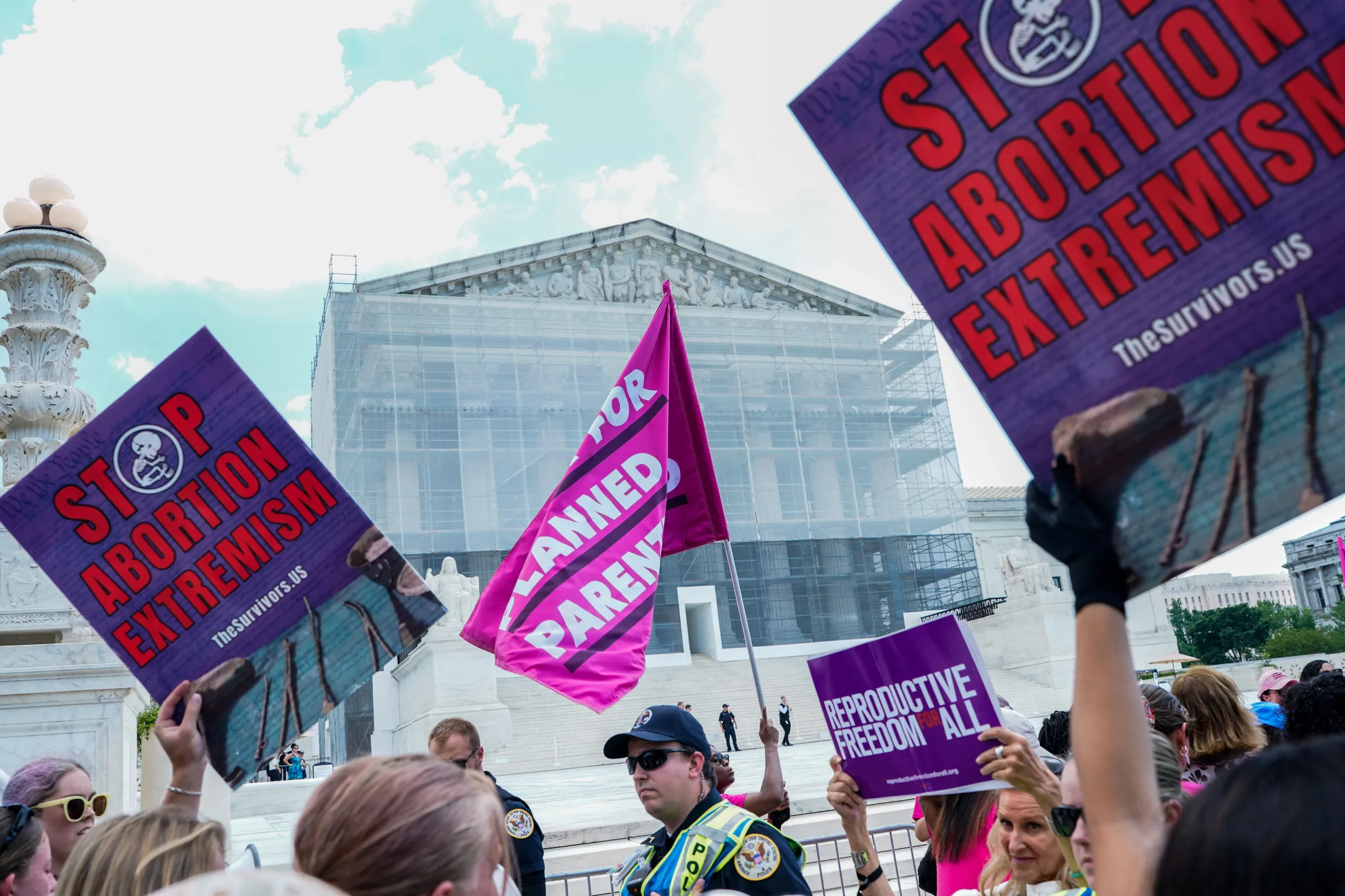
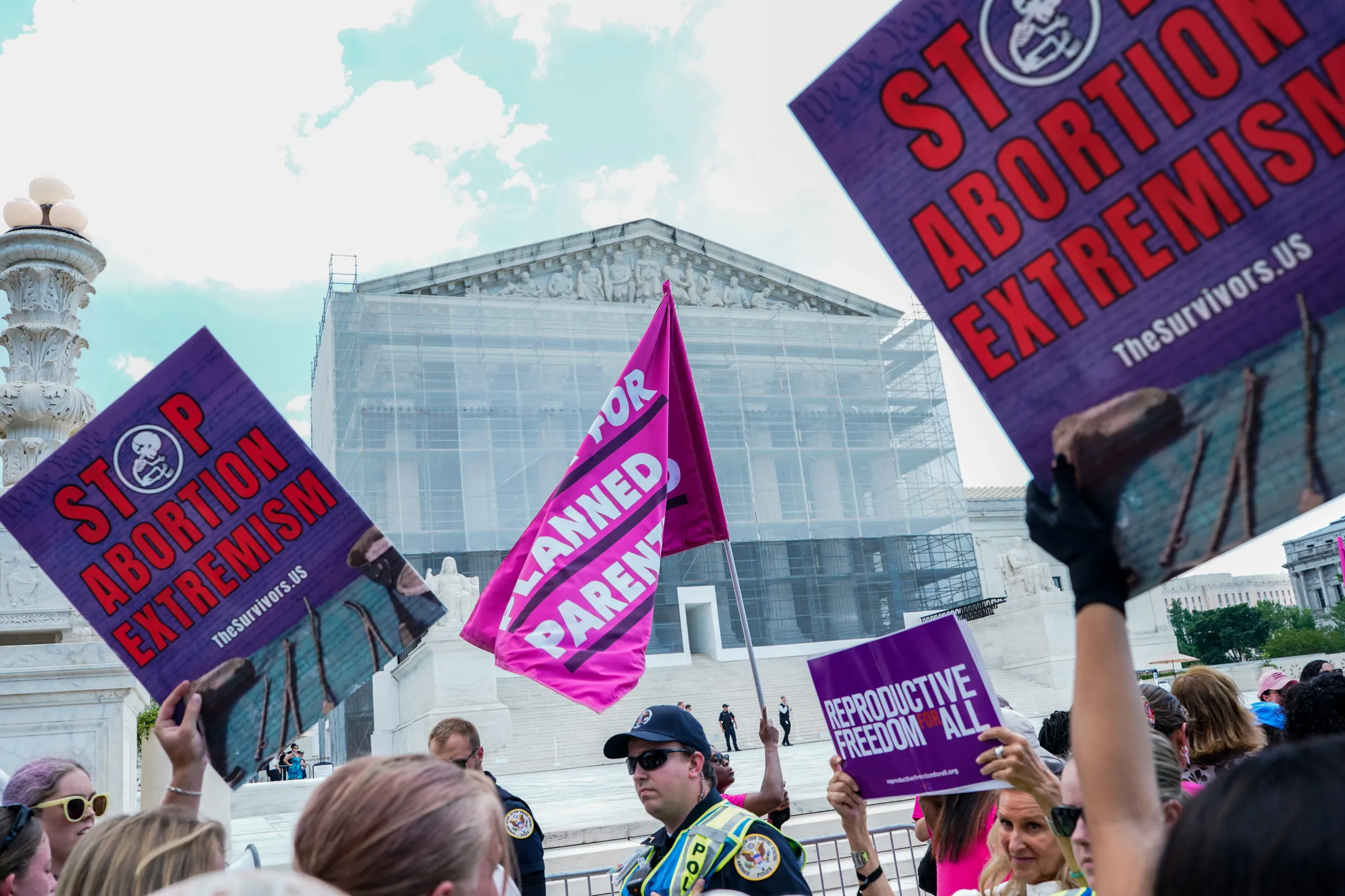
Anti- abortion activists face pro-planned parenthood and pro-abortion activists outside the court in Washington, D.C., U.S., June 26, 2025. REUTERS/Elizabeth Frantz
What’s the context?
New abortion restrictions proliferate in a post-Roe U.S. under Trump.
- Budget bill targets Planned Parenthood, abortion providers
- FDA approves new generic abortion drug
- States continue to pursue new restrictions post-Roe
RICHMOND, Virginia -Nearly one year into President Donald Trump's second term, U.S. abortion laws are now a hodgepodge of duelling restrictions and protections, stemming largely from the U.S. Supreme Court's 2022 decision to end what had been a constitutional right.
Both the federal government and individual states have continued to roll back abortion rights, with more than a dozen states now banning abortion outright or up to four months after the start of pregnancy, according to the Guttmacher Institute, a nonprofit research group.
Trump's administration has swiftly cracked down on abortion rights, from restricting access to veterans to defunding of Planned Parenthood, a non-profit group that provides a range of sexual health services, including abortions.
Shortly after taking office, Trump also pardoned about two dozen anti-abortion advocates who had been convicted of violating a law to promote free access to abortion clinics.
Where does abortion policy in the U.S. stand one year into Trump 2.0?
Planned Parenthood 'defunding'
Through Trump's One Big Beautiful budget bill, he and congressional Republicans followed through on a cause anti-abortion groups had been championing for years: the cutting of federal funds for Planned Parenthood.
"The Trump administration is committed to stopping ... taxpayer dollars pushing ideology on everyday Americans," White House spokesperson Kush Desai said in a statement to Context.
The law, signed in July, cut federal funding to nonprofit abortion providers by restricting the use of Medicaid funds, the government healthcare system for the poor.
In September, with help from other funding sources, Planned Parenthood still provided services to patients who use Medicaid at more than 100,000 visits.
"They're doing everything in their power to keep seeing patients, but without that support from the federal government ... that is not a sustainable way of providing care," said Laurel Sakai of Planned Parenthood Federation of America.
"Oftentimes, Planned Parenthood centres are the only health centre available to patients, particularly in rural communities or underserved communities."
The bill "is just a massive blow to access," even in states that have protected access to abortion, said Ryan Stitzlein, vice president of political and government relations at Reproductive Freedom for All, an abortion rights group.
Anti-abortion groups, though, hailed the move.
"To me, after so many years of being funded, that was a big win for the pro-life community," said Jor-El Godsey, president of Heartbeat International.
Veterans' access to abortion
After proposing a rule in August to restrict abortion access to veterans, the Department of Veterans Affairs is no longer providing access to abortion to veterans on VA health care plans, citing Justice Department legal guidance, the news outlet MS NOW reported in December.
The Center for Reproductive Rights said the move amounted to an effective national ban on abortion for veterans.
"Everyone should be appalled by this heartless policy," said Nancy Northup, the group's president and CEO. "President Trump said he would leave abortion to the states, but he continues to seize new opportunities to restrict it nationally."
The Justice Department opinion states that the VA is not legally authorised to provide abortions and the VA is complying with it immediately, said VA press secretary Peter Kasperowicz.
"DOJ's opinion is consistent with VA's proposed rule, which continues to work its way through the regulatory process," Kasperowicz said.
Abortion medication
Anti-abortion advocates had hoped Trump would use his administrative tools to crack down on abortion pills.
But the Food and Drug Administration (FDA) in October approved a new generic form of mifepristone, one of the most commonly used drugs in medication abortions.
The FDA is also planning to delay a more detailed safety study on abortion medication until after this year's midterm elections, according to Bloomberg.
If the FDA is slow-walking the study for political reasons, it is "misguided," said Kelsey Pritchard, from the anti-abortion nonprofit SBA Pro-Life America, expressing disappointment the administration had not moved to further restrict Biden-era rules allowing for the mail order of abortion drugs.
"The FDA Commissioner (Marty) Makary has done things to make it even worse, like approve a new generic mifepristone," Pritchard said.
Emily G. Hilliard, spokesperson for the U.S. Department of Health and Human Services, said the FDA is taking the necessary time for scientific review.
Legal attacks
Since the Supreme Court overturned Roe v. Wade, conservative-leaning states have pushed for further restrictions, including punishments for out-of-state doctors offering to provide abortions to women fleeing new crackdowns.
Nineteen states now have either near-total abortion bans, or bans of up to 12 weeks after the start of pregnancy, according to KFF, a health research group.
Eight states do not have an exception for rape or incest, and six states do not have a health exception for the mother, it says.
"We've seen a lot of states have an even stronger focus on criminalisation and essentially bringing the criminal legal system into reproductive health care," said Kimya Forouzan, principal state policy advisor with the Guttmacher Institute.
Forouzan pointed to the introduction of state legislation that attaches criminal penalties for distributing abortion pills or categorising the medicines as controlled substances.
A woman in Kentucky, which has a strict abortion ban, was charged in January with fetal homicide after apparently aborting her pregnancy using medication she had purchased online, local broadcaster WKYT News reported. Prosecutors later dismissed the homicide charge, because
Kentucky law exempts mothers, but she still faces lesser charges.
At the same time, Democrat-led states like California and Illinois have moved in the other direction by enshrining a right to abortion into state constitutions and passing laws that seek to protect doctors and abortion providers from being prosecuted elsewhere.
Voters in Virginia and Nevada could also decide whether to codify abortion rights in their state constitutions this year, while voters in Missouri are set to weigh in on whether to repeal that right from the state's constitution.
This story was updated at 13:53 GMT on Monday January 19, 2026, to add comment from Planned Parenthood Federation of America.
(Reporting by David Sherfinski; Editing by Anastasia Moloney, Ayla Jean Yackley and Jon Hemming.)
Context is powered by the Thomson Reuters Foundation Newsroom.
Our Standards: Thomson Reuters Trust Principles