

Can the fashion industry adapt to a warming world?

Opinion
Opinion
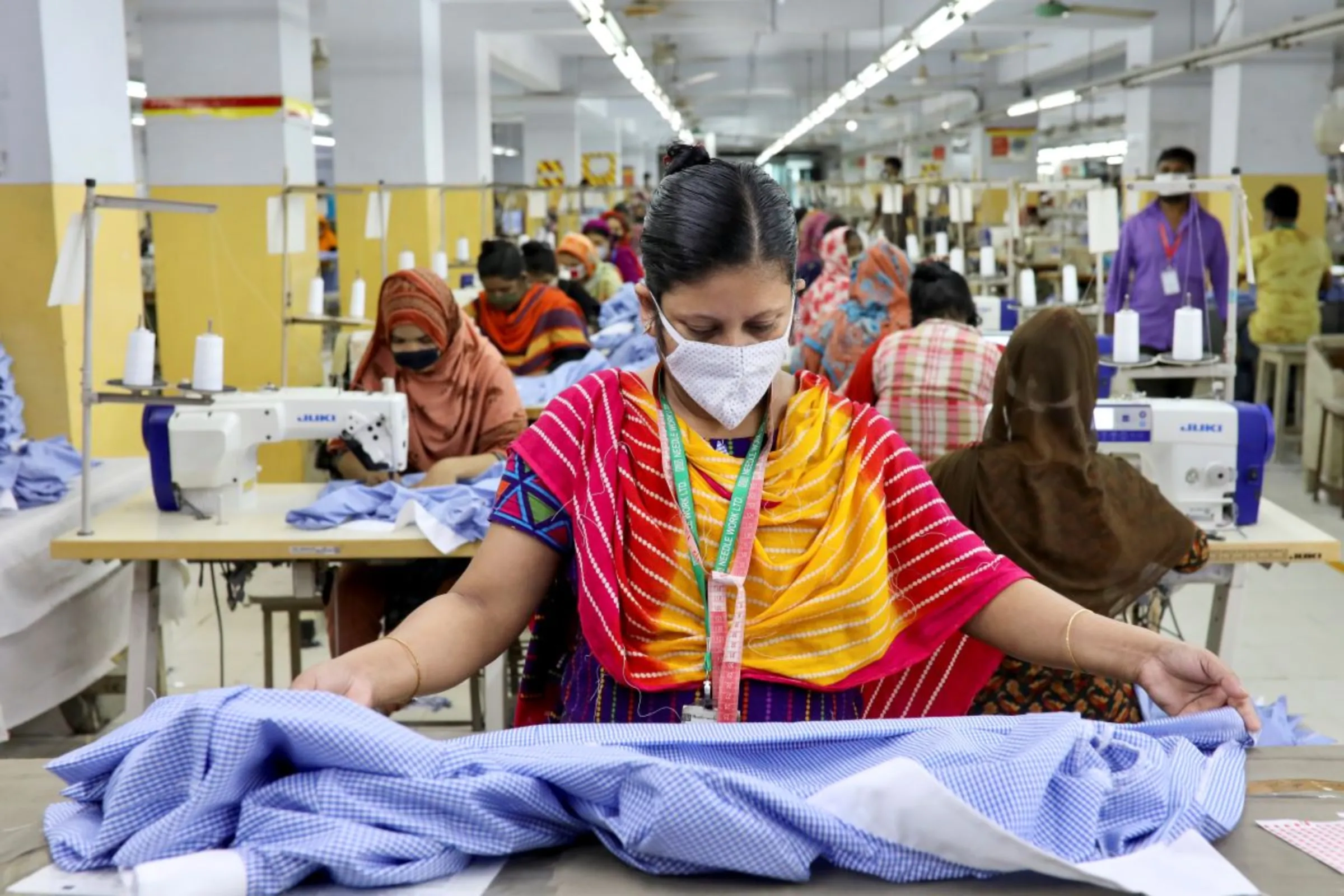
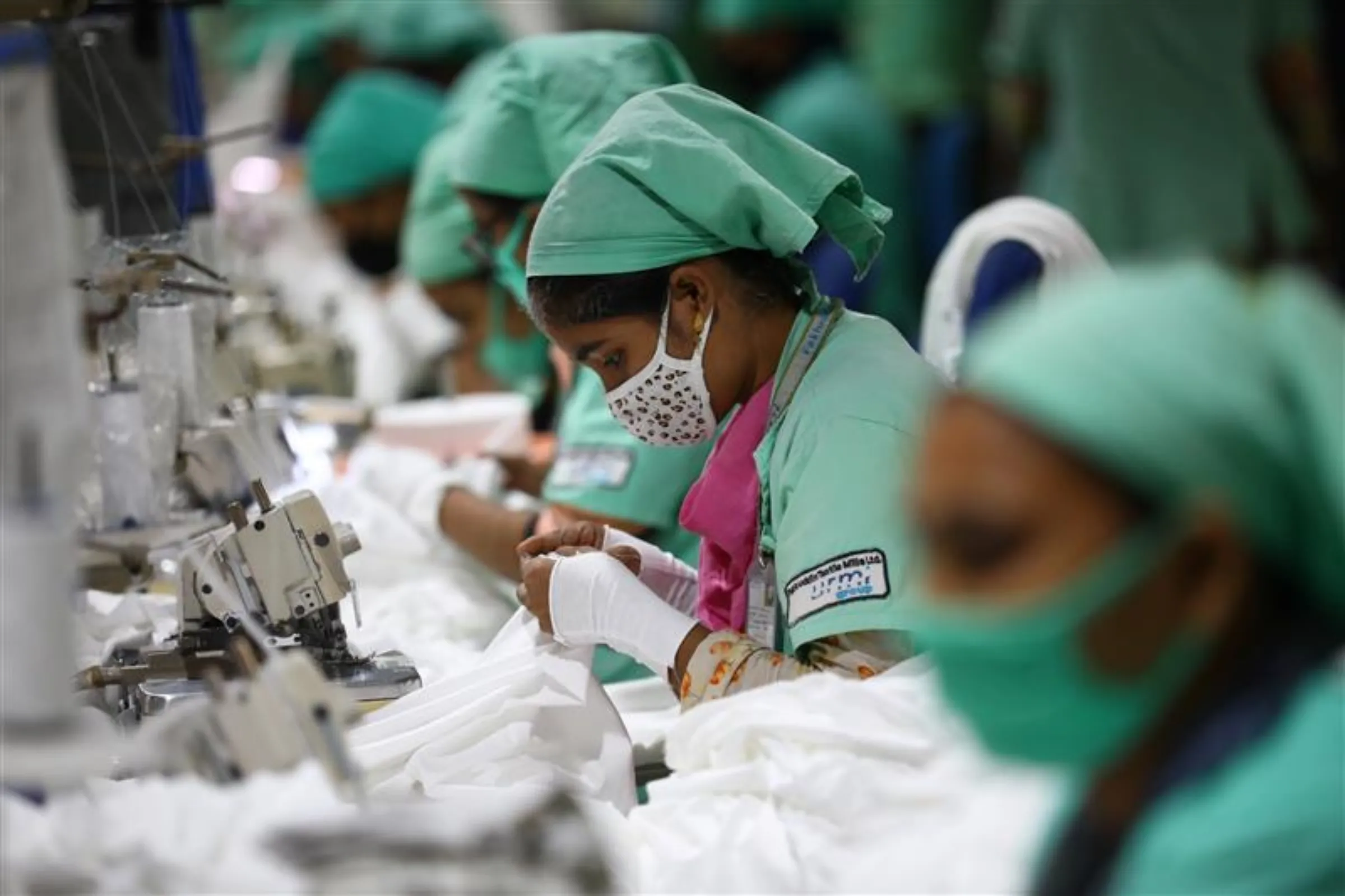
A woman works in a garment factory in Dhaka, Bangladesh, May 3, 2020. REUTERS/Mohammad Ponir Hossain
COP30 agreed to triple adaptation finance, but the fashion industry needs adaptation measures now.
Jason Judd is the executive director of Cornell University’s ILR Global Labor Institute and Kalpona Akter is the co-founder and executive director of Bangladesh Centre for Workers Solidarity.
Ten years ago, the 2015 U.N. Paris climate agreement focused on cutting planet-heating greenhouse gas emissions, known as ‘mitigation’ measures. This was the top priority in the Global North, spelled out in Article 2 of the agreement.
Yet the priority for many in the Global South - dealing with extreme heat and intense flooding, or ‘adaptation’ measures - lives further down in Article 7. And measured in terms of political energy, scientific ambition and financing, the distance between the two Articles is enormous.
This year, countries negotiating at the U.N. COP30 summit in Belém, Brazil, were charged with filling out the Global Goal on Adaptation (GGA) first proposed by negotiators in the Global South in 2013. These are measures designed to track progress on adaptation.
While the adaptation funding goal has been tripled, the delivery date has been pushed back five years to 2035. And the conference failed to nail down the indicators needed to track progress.
Why so slow? In a pre-conference interview with Carbon Brief, an author of the U.N. IPCC scientific reports Lisa Schipper said wealthy countries “don’t want to be held accountable and to be forced to pay for things.”
That will sound very familiar to the fashion industry’s buyers, manufacturers, workers and campaigners.
On accountability, fashion has been having it both ways for decades, avoiding real regulation and blaming failures on its suppliers. And when the pressure to fix a problem becomes unmanageable, such as collapsing factories or violence against women workers, the apparel industry calls for collective action or a global standard. Both are hard to produce because so many different interests have to be accommodated. That has also suited the industry which doesn’t like to make investments that it can avoid.
Will climate adaptation be different?
Extreme heat was not a priority for fashion brands and retailers in 2023 when the Global Labor Institute (GLI) published its “Higher Ground?” report with Schroders on the economic and human costs of extreme heat and intense flooding. It is now acknowledged in the industry as a major issue.
This makes sense because climate breakdown is bad for everyone - workers, manufacturers, buyers - and it is accelerating in many of the apparel industry’s favourite supplier countries.
In GLI’s analysis, failure to reduce heat in factories and flooding around them will cost the apparel industry $65 billion in earnings and about one million potential jobs by 2030 in Bangladesh, Cambodia, Pakistan and Vietnam.
And dealing with high heat stress has some upside for everyone. Safer factories and homes mean healthier workers, higher productivity and better margins.
Finally, workers toiling in 35 or 40 degrees Celsius (95 to 104 degrees Fahrenheit) and high humidity is the return of the literal sweatshop. That’s never in style.
Everyone in the business knows that the problem the industry faces is not a technical one. Figuring out how to cool workers, pay for the improvements and hold down carbon dioxide emissions is not that hard. Top suppliers are already doing it.
The problem is a political one. It’s about power: who is going to pay? At present, workers are paying with their health.

Workers toiling in 35 or 40 degrees Celsius and high humidity is the return of the literal sweatshop. That’s never in style.
Buyers and their manufacturers, governments and lenders should instead be sharing the costs of cooling workers and workplaces via binding agreements such as the International Accord, which requires fashion brands and manufacturers to meet safety and health standards in Bangladesh and Pakistan.
In response to findings on extreme heat like those from Cornell’s GLI, the Accord announced in December that it would begin work to track and reduce extreme heat for workers.
As well as physical adaptation like air conditioning, the industry and governments need to make social adaptation investments, such as living wages, social protections and bargaining rights.
How will they help cool workers’ homes overnight in a week-long heat wave, and shore up workers’ health when waste-tainted water fills their streets? Or deal with an abusive supervisor when work is dangerously hot?
So, who will pay? The promised billions and trillions of dollars in just transition finance must seem very far away for apparel workers and their employers in Dhaka, Phnom Penh and San Pedro Sula.
The finance needs to be broken down into manageable packages for workers and employers to fund the adaptation outcomes that matter most: living wages, safer factories and cooler homes. That will be progress.
Any views expressed in this opinion piece are those of the author and not of Context or the Thomson Reuters Foundation.
Tags
- Adaptation
- Climate policy
- Corporate responsibility
Go Deeper
Latest on Context
- 1
- 2
- 3
- 4
- 5
- 6