


Supported By:
Drug inspectors in India struggle to keep 'world's pharmacy' safe



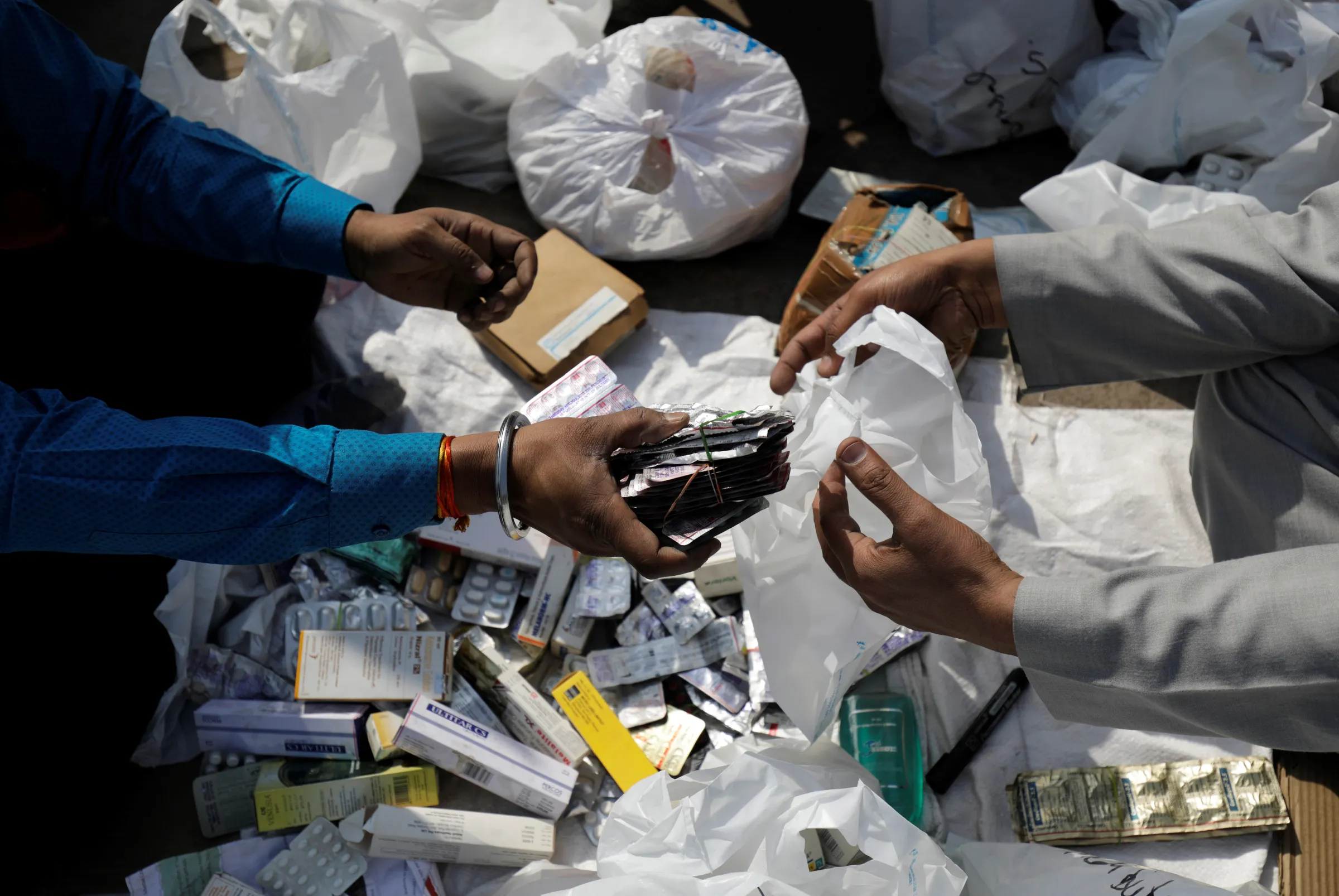
A pharmacist speaks to a patient at the pharmacy at a hospital in New Delhi, India, June 22, 2023. REUTERS/Anushree Fadnavis
What’s the context?
Weak regulatory oversight in the world's largest producer of generic drugs means that substandard drugs may reach pharmacy shelves.
- Steroid made by Zee Laboratories found to contain bacteria
- Regulators pursue prosecutions with few convictions
- India makes a fifth of the world's generic medicines
BENGALURU, India/LONDON - When Indian drug inspector Satish Chavhan sent off samples of a steroid injection for quality testing, it took seven months for the state laboratory in Mumbai to report the medicine was contaminated with bacteria.
The delay meant that more than 100 vials from the contaminated batch had been administered to patients before it was ordered off the shelf in Wardha district, located in the state of Maharashtra, according to Sumant Wagh, a senior health official in the district.
The methylprednisolone steroid was produced by Zee Laboratories, a pharmaceutical company that manufactures generic drugs in India.
According to a recent investigation by The Bureau of Investigative Journalism (TBIJ) and Context, Zee Laboratories was found to have failed at least 86 quality tests by Indian regulators and has faced multiple court cases.
The Indian Pharmacopoeia Commission, to which doctors and patients can report adverse events, declined to say whether it had received reports of injuries or deaths linked to any medicine made by Zee Laboratories.
Zee Laboratories is part of the booming Indian pharma industry, which makes a fifth of the world's generic drugs - cheaper copies of a medicine once a patent expires - earning it the mantle of the "pharmacy of the world."
The contaminated sample of methylprednisolone, which was found in Wardha in September 2022, illustrates the dangers as India's pharmaceutical regulators struggle to ensure that thousands of manufacturers comply with basic safety standards.
Weak regulatory oversight can sometimes have deadly consequences, such as when Indian-made cough syrup caused the deaths of at least 24 children in India.
Chain reaction
Methylprednisolone is a powerful steroid used to treat rheumatoid arthritis, multiple sclerosis and severe cases of COVID-19.
It is typically administered by specialist doctors to critically ill patients in hospitals, said SP Kalantri, a professor of internal medicine at the Mahatma Gandhi Institute of Medical Sciences in Sevagram, located in Wardha district.
"Zee Laboratories firmly rejects any suggestion that it knowingly manufactures substandard medicines," the company said in a statement in response to questions about the quality of medicines it manufactures across multiple plants.
Rohit Mukul, the son of Zee Laboratories' founder Rajeev Mukul and who runs a chain of chemists that largely sells Zee Laboratories' medicines, said every batch is tested at multiple stages.
Sterility-related deviations might arise from "factors beyond the manufacturer's control such as ... improper storage at intermediary points or exposure to unfavourable climatic conditions," he said in a statement.
If a bad drug reaches a patient, it is not down to a single slip-up, said Chaitanya Kumar Koduri of US Pharmacopeia, an organisation that sets standards for medicines in the United States and internationally.
Manufacturers are supposed to check raw ingredients, ensure employees are following quality practices and test each final batch, and regulators are expected to inspect plants frequently.
"You're talking about missing three or four levels of testing," Koduri said.
Inspectors like Chavhan, who works at Maharashtra's Food and Drug Administration (FDA), together collected about 100,000 samples in 2022 across the country.
Government-run pharmacies are required to purchase medicines at the lowest prices possible and may turn to manufacturers that could be tempted to cut corners, said Chavhan.
"Being a drug inspector, I choose such hospitals where - because of a low (price) of supply and the difference in price - many of the manufacturing companies supply such (poor quality) products to the government," he said.
India's central drug authority and the Maharashtra FDA did not respond to requests for comment.
It is difficult to determine how many inspectors are employed by the 37 regulators across India's states and union territories. The Central Drugs Standard Control Organisation, headquartered in Delhi, has 419 posts for inspectors, but 230 of the posts were vacant as of November 2024.
Between them, state and central inspectors are expected to routinely inspect each of India's 10,000 or more manufacturing facilities, as well as pharmacies, and take action when something goes wrong.
Chavhan was the only drug inspector in Wardha at the time, responsible for up to 950 pharmacies, three drugmakers, a few cosmetics manufacturers and a medical oxygen plant, he said.
Legal cases
After Chavhan was posted to Mumbai, his colleague Manish Shriram Chaudhary took over the case in November 2023 and six months later filed a legal complaint against Zee Laboratories and its executives for allegedly manufacturing a substandard drug, a criminal offence under the Drugs and Cosmetics Act.
The case against Zee Laboratories has not yet been heard in the Wardha court.
Drug inspectors do not have the training or resources to build strong criminal cases in which the burden of proof is high, said Shri Singh, a lawyer who has fought cases under India's drugs laws.
Companies do not always cooperate with requests for information required to build cases against them, drug inspectors told TBIJ and Context.
The case against Zee Laboratories is one of the 70 that Chaudhary has filed against drug manufacturers for violations in his 13 years working for Maharashtra's FDA.
He has only won two convictions for the offence of manufacturing substandard drugs, he said.
"Every month we file a case," he said, and "the output is zero."
(Editing by Ayla Jean Yackley and Amruta Byatnal.)
Context is powered by the Thomson Reuters Foundation Newsroom.
Our Standards: Thomson Reuters Trust Principles
Tags
- Consumer protection
- Underground economies
- Corporate responsibility