
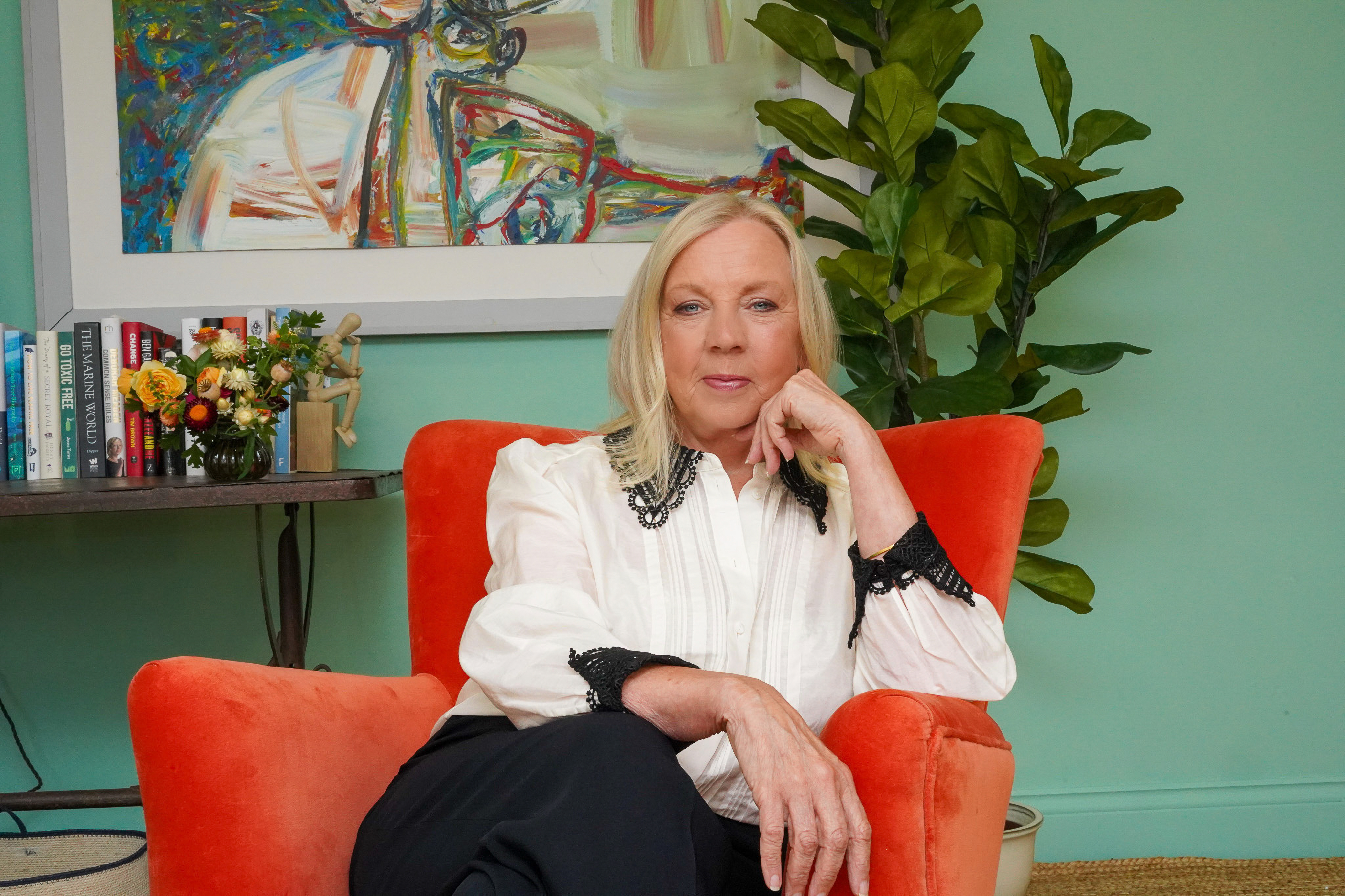
LONDON – Businesswoman Deborah Meaden is a familiar face for British television audiences, starring as an investor on “Dragons’ Den,” a show where budding entrepreneurs seek financing for new ventures.
But Meaden has also become well-known for her public stance on environmental issues, views she has held since writing a thesis about climate change as a teenager.
Meaden has invested in several new sustainable businesses, including food company Bold Bean Co, refillable deodorant company Fussy and EV charging firm Kerbo Charge.
She spoke to Context about what she has learned about making business sustainable.
You’ve worked with green startups, but also traditional businesses. What have you learned about the latter’s ability to transition?
I’m glad you made the distinction. A lot of the startup businesses and SMEs that I’m investing in and working with, they give me hope because they are fundamentally founded on solving a planetary problem.
However, when you have got legacy, it’s not even that you’ve got to change the things going forward; you’ve got to undo and change systems and processes, and that can be hard. I think the hardest thing is finding the space and the energy, and the thinking time and the experience, to do that.
A lot of (businesses) have got their mind wrapped around net zero. What they don’t necessarily know or understand is what they can do about nature, because it can be so far down the supply chain.
In the last year, have you heard of more ‘green hushing,’ with businesses wary of addressing environmental issues because of politics?
The larger organisations, absolutely. I think there was already a reticence in terms of green hushing. I had a podcast called The Big Green Money Show, and that was all about saying: ‘Look, come on, this is a safe space’. Nobody is perfect, and we need to be a little bit more pragmatic.
I’m not saying pragmatism should allow people to get away with stuff. I think we should hold people to account. But I do think we need to understand there is a transition going on here. There is still a fear of saying what they are doing, because every business is doing something that they could definitely do better.
And once we’ve decided that a business is something, we don’t review it. (If) it’s something that happened 20 years ago, we’ll still be going: ‘Oh, they’re a bad organisation, aren’t they?’ But often it’s those organisations that have got something wrong that are actually even more motivated to get things right, because they’ve seen the damage that it’s done to the businesses.
There’s a sense that eco-friendly businesses are for the wealthy. What will it take for them to be more mainstream and inclusive?
I think it’s a genuine issue. When markets open up, they’re usually smaller markets. That can mean things are more expensive than they ultimately need to be, because there are not enough people demanding them and, therefore, the supply is quite expensive. So that is a fact of life.
It’s not a criticism, because what (the middle class) can do is … prove a market, and they can grow the market. And as the market grows, the prices come down. Transitions cost money because you always have to change processes. You often have to make a big capital expenditure.
With these business shifts, a lot of the new jobs are in different places. Do you have any thoughts on what needs to happen in terms of the potential dislocation?
One of the big forever changes that we’re going to see is people are going to need to be adaptable. Because the world is changing at an ever faster pace.
A lot of the technologies that we’re talking about, a lot of the AI that we will be able to use, will actually mean a democratisation of some of these high-value jobs because we’ve got an opportunity to put these things where they need to be.
And I think that some of the regions are going to benefit from it. Where I am in Somerset (in southwest Britain), we’ve got a big EV battery factory going in, and this is an area with low employment, very few opportunities for young people. That should be seen as a good thing.
This interview has been edited for clarity and brevity.
(Reporting by Jack Graham. Editing by Ayla Jean Yackley.)