Context is powered by the Thomson Reuters Foundation Newsroom.
Our Standards: Thomson Reuters Trust Principles



View from Lörmecke-Turm tower of damaged spruce forest, Arnsberg, Germany Nov. 5, 2025. Thomson Reuters Foundation/Joanna Gill
To breathe new life into Germany's "green lung" of North-Rhine Westphalia, forest engineers bet on biodiversity.
ARNSBERG, Germany - Once visitors who braved the 200 steps of the Lörmecke-Turm tower in Germany's Arnsberg forest park would be rewarded with a stunning view across a dense canopy of giant Norwegian spruce.
Now all they see from the 35-metre viewing tower is a denuded plateau. The trees have gone, struck down after a devastating infestation of bark beetles in 2018.
The "calamity", as experts call it, happened so fast that 60-year-old trees were lost in just weeks here in the forest, a paradise for nature-lovers in North Rhine-Westphalia, along Germany's border with the Netherlands and Belgium.
"It's shocking for me and every forester," said Petra Trompeter, who works for Arnsberg city's forestry department, squinting through the low winter sun from the base of the tower.
The foundations for mass dieback were laid over many years as storms and drought created the perfect conditions for the bark beetles to devour row-upon-row of spruce trees.
Foresters know that worse might yet be to come as global warming reaches above 1.5 degrees Celsius (2.7 degrees Fahrenheit) above the 1850-1900 pre-industrial period, with 2024 confirmed as the first year to breach this level, according to the World Meteorological Organization.
In a hotter world, climate change-related disasters are expected to increase in frequency and intensity, threatening forests' ability to absorb carbon, as well as thousands of jobs in the tourism and timber sectors.
In May, Germany's independent Expert Council on Climate Issues said the country could miss post-2030 climate targets as forests and wetlands shift from functioning as carbon sinks to become sources of emissions due to forest degradation.
Now, forest engineers are working on ways to future-proof forests in North Rhine-Westphalia under a European Union-funded scheme that includes mixing tree varieties to build resilience.
"Even before the disaster, we were working on making the forest more structurally rich and diverse," said Trompeter. "The calamity has forced us to do this more quickly."
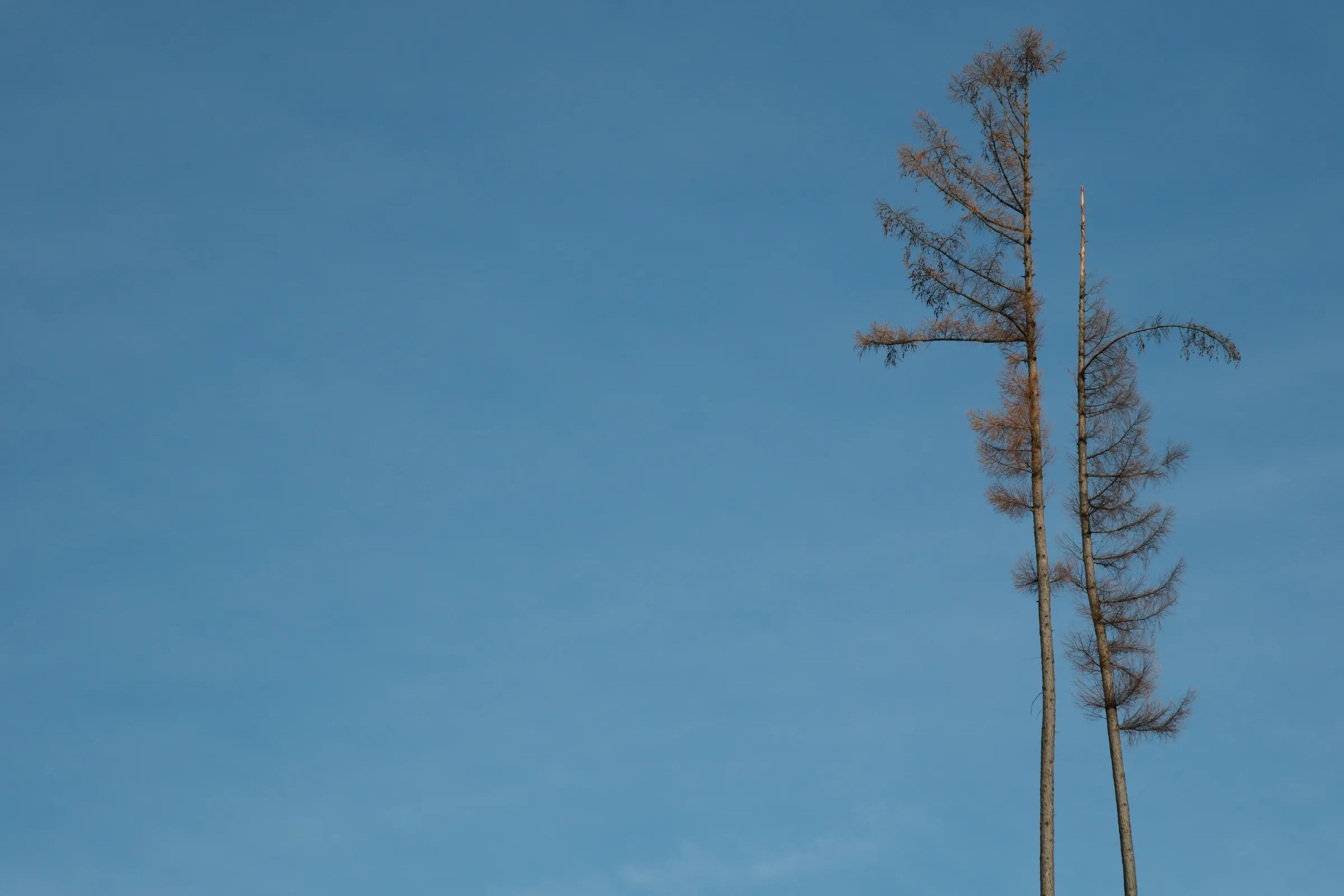
Damaged trees, Arnsberg, Germany Nov 4, 2025. Thomson Reuters Foundation/Joanna Gill
Damaged trees, Arnsberg, Germany Nov 4, 2025. Thomson Reuters Foundation/Joanna Gill
Fast-growing spruce plantations sprung up in Germany after World War Two as a way to pay off some reparations owed to Allied Forces by harvesting timber.
Timber producers have continued to favour the species for its quick uniform growth.
But these single-species plantations have made North Rhine-Westphalia's forests particularly vulnerable to heat, drought and pests.
"It's high-risk forestry," Siim Kuresoo, a campaigner with Fern, a Dutch forest protection NGO, told Context.
If everything goes right, there are good returns, but when mass tree losses occur due to extreme weather, they are viewed as "inevitable". Monoculture plantations are also partly to blame for Germany's forests losing the ability to absorb carbon.
"Natural forests are able to hold way more carbon," he said.
Diversification is seen as a solution, and it is being trialled across Europe.
Under the 20-million-euro SUPERB project, led by the European Forest Institute and funded under the EU's Green Deal, forestry experts have set up 12 demonstration sites from Sweden to Spain, including in Arnsberg, to restore habitats and transform monocultures.
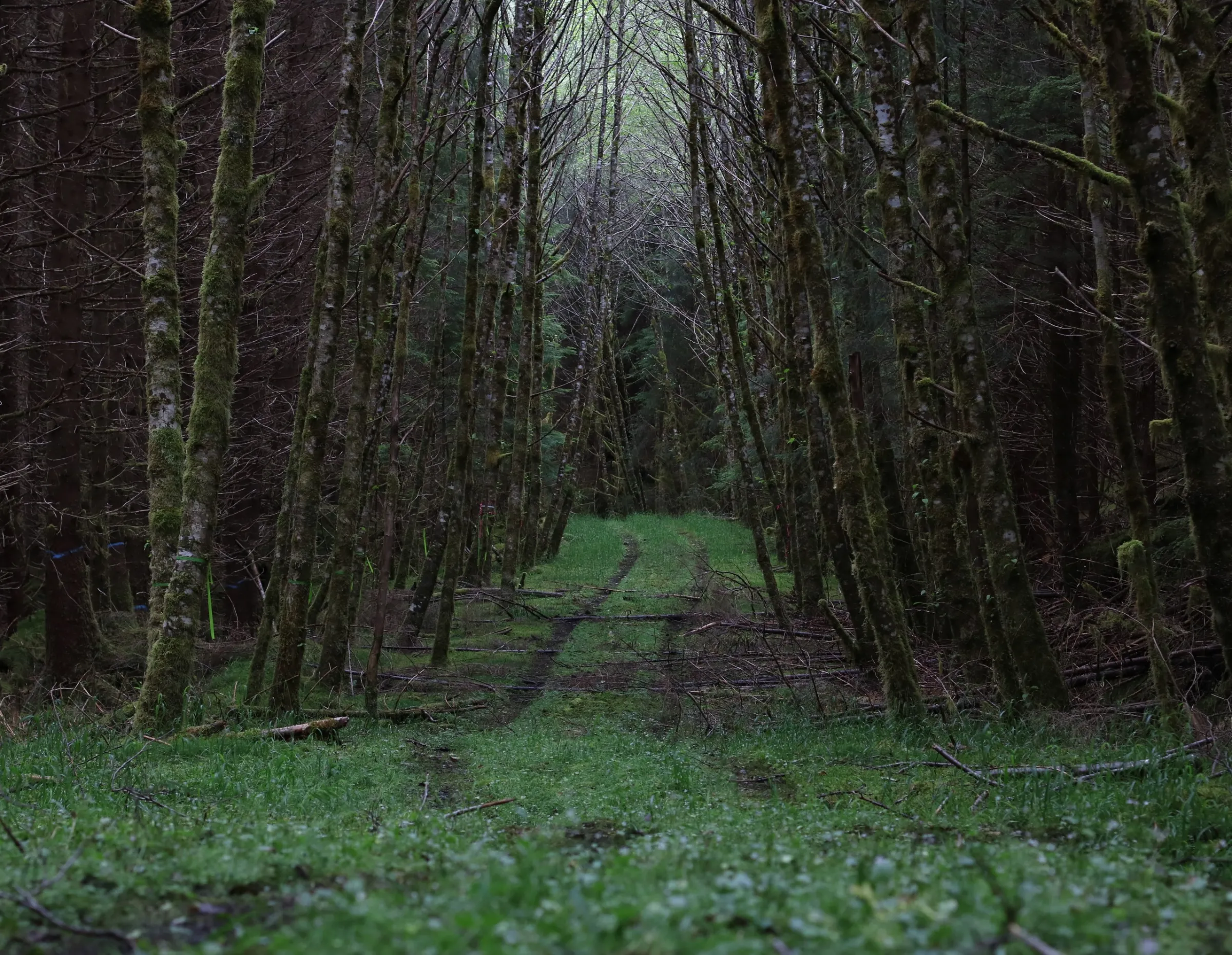
The Arnsberg site covers 34 hectares of public and private land. Forestry experts carefully selected a mix of four species of conifers and broad leaf trees that they believe could adapt to the altitude and climate and withstand the hotter, drier conditions likely in the future.
"It's better to look at the worst-case scenario as a guiding principle," said Marcus Lindner, head of resilience at the European Forest Institute.
While most forestry experts say variety is critical, not everyone agrees on how to achieve this.
Some favour natural regeneration, others curated planting of local species, while some want to experiment with non-native trees.
That, however, is not possible in North Rhine-Westphalia where nature protection rules only allow local species, Trompeter said. "And that's where we reached our limits."
Trees also play critical role in the economy, supplying 76 million cubic metres of timber every year, 750,000 jobs in forestry and timber, as well as boosting rural economies through eco-tourism, according the German Agriculture Ministry.
The hilly Sauerland region of North Rhine-Westphalia is a popular destination for hikers, but the mass dieback made the area unrecognisable for some visitors, said Rouven Soyka, press officer for the Sauerland Tourism board.
"Nature tourism is affected in every way. We are a classic outdoor region, it's important to have intact nature."
But many forest owners cannot afford reforestation without state subsidies, which do not cover all costs.
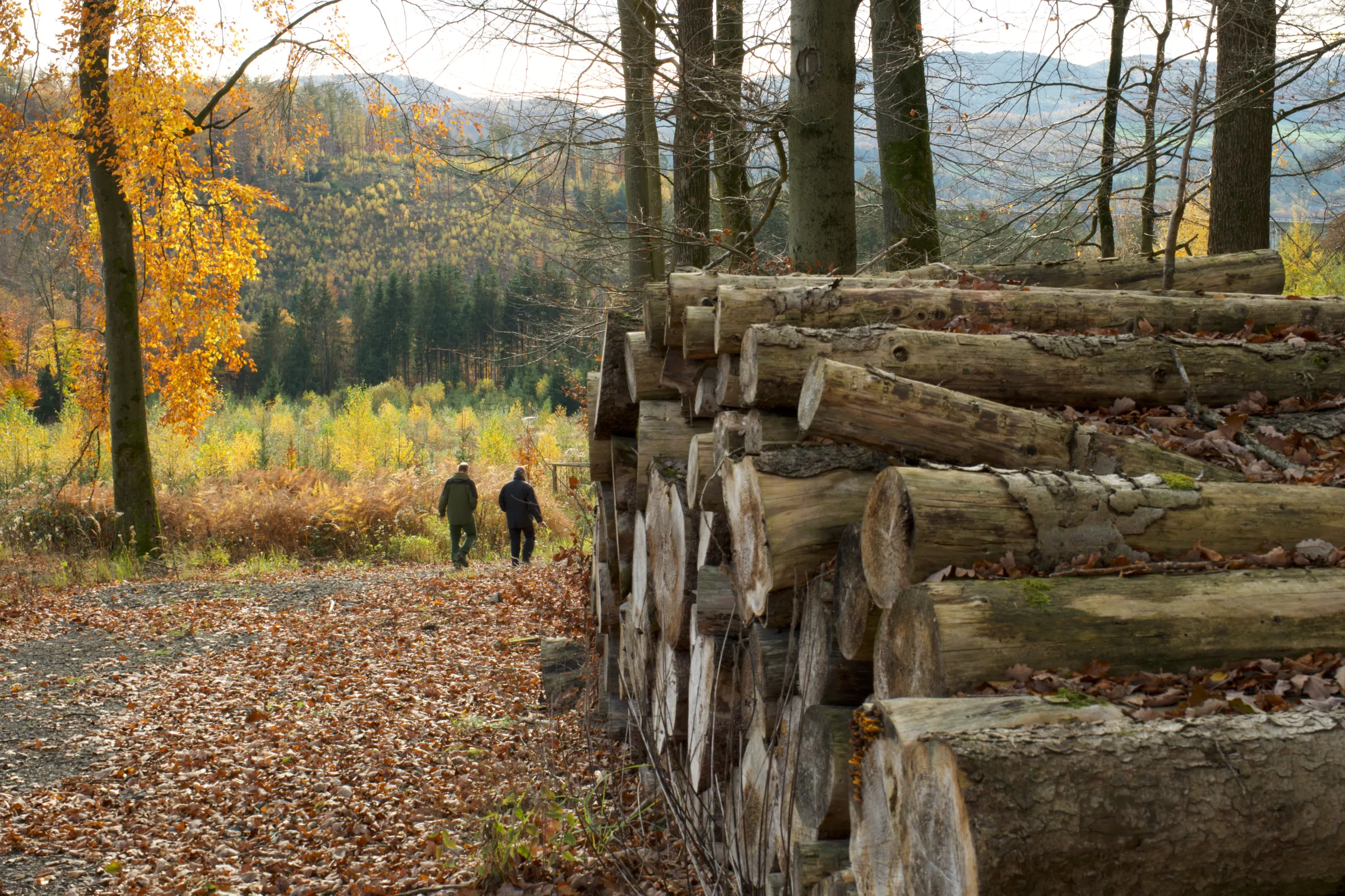
Timber pile near restoration site Arnsberg, Germany Nov. 5, 2025. Thomson Reuters Foundation/Joanna Gill
Timber pile near restoration site Arnsberg, Germany Nov. 5, 2025. Thomson Reuters Foundation/Joanna Gill
At the Jungermann tree nursery, owner Peter Jungermann, says he has to think twice before investing in growing more high-maintenance broad leaf varieties over market-friendly conifers, especially given financial pressure on forest owners.
If he gets the call wrong on which tree to grow it can become an" existential threat for the nursery".
Shifting political winds also complicate long-term planning.
Key laws meant to be part of the EU's Green Deal, such as the nature restoration bill to set binding targets for reviving damaged ecosystems, have been watered down in the past year due to backlash from businesses and farmers.
And it is not clear yet how much money will be allocated to forest restoration in the 2028-2034 EU budget, worth 2 trillion euros ($2.35 trillion). Negotiations will be held over the next two years.
Germany's 2026 budget prioritises defence and infrastructure spending as the government attempts to revive the sluggish economy.
"Forests are the basis of life for us humans, for the entire planet," said Trompeter. "Where else should it be spent than to preserve nature and make it climate-resilient?"
($1 = 0.8522 euros)
(Reporting by Joanna Gill in Brussels; Editing by Jon Hemming.)
Context is powered by the Thomson Reuters Foundation Newsroom.
Our Standards: Thomson Reuters Trust Principles