


Tough asylum laws 'toxic' to mental health of young refugees

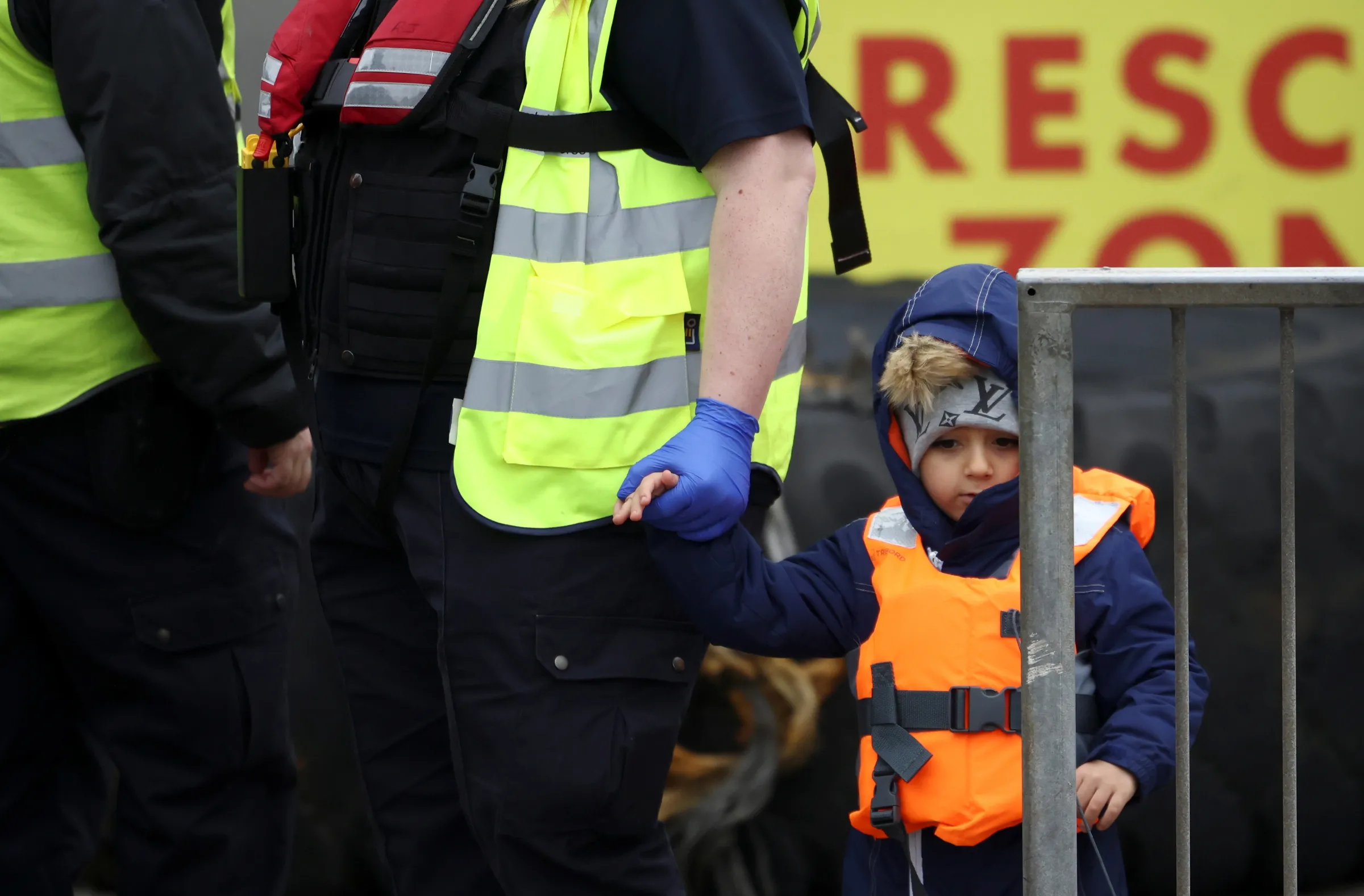
A child is escorted, after being brought ashore by a Border Force vessel, in the port of Dover, Britain December 16, 2021. REUTERS/Henry Nicholls.
What’s the context?
Many refugee children are spending their childhoods living in limbo, and experts warn of lifelong mental health impacts.
- Temporary protection visas prevent refugee integration
- Refugee children face lifelong mental health toll
- Children risk anxiety, suicidal thoughts, experts say
LONDON - When Fareed learned that Syrian ruler Bashar al-Assad had been toppled on Dec. 8, 2024, it was both the best and worst day of his life.
Fareed, who has lived with his family in Britain since 2023, celebrated the end of nearly 14 years of war in his home country. But the news sent his son into a deep depression.
"I wanted my kids to remember this day as a really special day. But my son immediately asked me, 'Baba, would England now kick us out to go back to Syria?'" Fareed, who did not want to use his last name, told Context.
Countries including Britain, Germany and Denmark paused asylum applications for Syrians after Assad's fall and are now considering their repatriation, arguing the security situation has improved.
Fareed's teenage son said he would rather die than return to Syria.
"I put all my savings, all the money I had, everything, because I wanted my kids to be safe. At that moment, I thought I failed," said Fareed, who is from Aleppo, where 150,000 people fled after clashes between Kurdish and government forces in early January.
His son's anguish is mirrored among young refugees across Europe where tough asylum laws are preventing a generation from fully integrating into host countries, the United Nations and rights groups say.
The harsher policies come as right-wing parties keen to restrict immigration gain support in many European countries.
Short-term protection visas, pending applications and the threat of deportation are damaging the mental health of young refugees, who are already more likely to have anxiety, suicidal thoughts and depression due to their traumatic journeys, psychologists say.
"What we know about the mental health of children is that security is critical," said clinical psychologist Katy Robjant, director of national clinical services at Freedom from Torture, a migrant charity.
"So to put people in that position where they build a sense of stability and maybe start to recover ... and then to potentially pull the rug from under them and say, 'You have to go back,' is exceptionally damaging," said Robjant.
Temporary protection
In November, Britain's Labour government announced it would no longer offer refugees permanent protection - a policy similar to measures introduced by Denmark in 2015 when millions of migrants, mostly Syrians, arrived in Europe seeking safety.
Refugees had previously been able to settle permanently after living in Britain for five years. That number has quadrupled to 20 years, and their status will be reviewed every 30 months.
In December, Syrians in Britain said the Home Office, which oversees immigration, had written to them threatening to end their refugee status unless they could prove they still needed protection.
"This is not a mentally healthy policy. Living your life in limbo, not having security and certainty is toxic to good mental health," said Oliver Chantler, head of policy and public affairs at Britain's Mental Health Foundation.
Syrian mental health professional Hadi Althib said removing a sense of safety from refugees creates a hypervigilant, stressful state.
"I know children who have suicidal ideation because of this exhaustion that they are witnessing from their parents."
'Us and them'
Three-quarters of refugee children in Europe interviewed by Save the Children reported negative emotions including despair, fearfulness and having nightmares, the children's charity found in 2024.
Children living indefinitely in a deportation centre in Denmark showed signs of sleep and eating disorders, anxiety and nightmares, it also said.
"Anyone would be able to see the difficult, long-term impact this would have into adulthood. It's certainly not an efficient way of ... building a stable and solid generation ahead," said Federica Toscano, senior advocacy advisor at Save the Children.
Mette Blauenfeldt from the Danish Refugee Council said temporary refugee visas in Denmark could cause further societal issues as children grow up.
"What good is it to have started their life by creating an 'us and them' feeling?" said Blauenfeldt, head of knowledge and development at the charity's integration department.
"When they grow up, there's an expectation for them to integrate. But you never really planted that seed or nurtured that," she said in a video interview.
Mina Fazel, professor of child and adolescent psychiatry at Oxford University, said such division can also breed bullying and ostracisation, particularly in schools, with refugee children quickly "othered".
'We can't do anything'
Mohammed was five when he left Syria in 2011, moving to Egypt and then Britain. The 19-year-old said he and his Syrian friends - scattered across Germany and Sweden - have always felt like outsiders.
"Our generation doesn't really have a sense of belonging to anywhere, because we left Syria so young."
Mohammed, who used a pseudonym, wants to study medicine, but has been unable to enrol at university because his family's permanent residency applications have been pending since they applied in October 2024.
"The most frustrating part is that we actually can't do anything. We just wait and wait and hope for the best."
Alice, a 15-year-old Ukrainian who has lived in Britain since 2022, is also worried about applying for colleges as her visa is set to expire later this year.
Most Ukrainian refugees in Britain are on special temporary visas that do not lead to permanent settlement and must re-apply every few years.
"I'm really working hard, (but) it doesn't bring me anywhere. I just don't know where to be, what to do," said Alice, who is from Kyiv and did not want to use her real name.
"I have a friend in Ukraine, and she sends me voice messages, crying, saying how she lies in the bathroom, and I can hear the bombs there. There's no life. It's really scary ... to think about that."
(Reporting by Lin Taylor, Editing by Ayla Jean Yackley.)
Context is powered by the Thomson Reuters Foundation Newsroom.
Our Standards: Thomson Reuters Trust Principles
Tags
- Government aid
- War and conflict
- Migration


Featured

Go Deeper
Latest on Context
- 1
- 2
- 3
- 4
- 5
- 6