Context is powered by the Thomson Reuters Foundation Newsroom.
Our Standards: Thomson Reuters Trust Principles


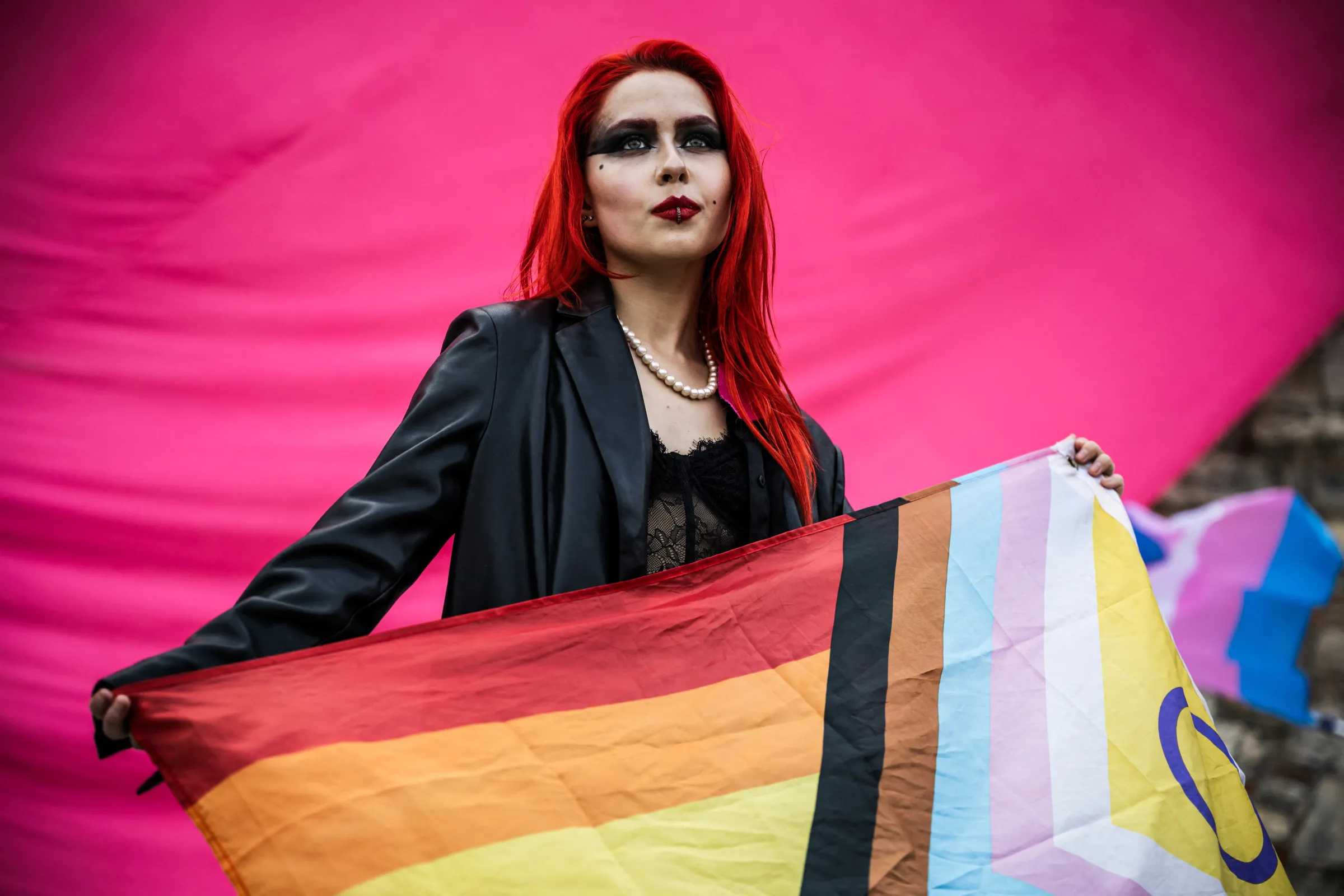
A woman holds a flag during a march in Budapest, Hungary, March 30, 2025. REUTERS/Marton Monus
Sports bans for trans women, anti-LGBTQ+ bills in Ghana and Kazakhstan and hope for intersex rights - some key issues to watch.
LONDON - After a year marked by legislative setbacks and devastating cuts to funding, the outlook for LGBTQ+ rights in 2026 could be daunting, with elections, court decisions and legal reforms likely to affect policies and people around the world.
After taking office last year, U.S. President Donald Trump ended years of funding for global rights initiatives and HIV prevention, while lawmakers in Ghana, Kazakhstan and Turkey clamped down on LGBTQ+ rights.
In a see-saw year, Thailand and Liechtenstein embraced marriage equality and Lithuania celebrated its first same-sex civil partnership, but Burkina Faso and Trinidad and Tobago criminalised gay sex.
Courts are set to rule on LGBTQ+ rights in Japan, Botswana and Hungary, and election outcomes in Uganda, Peru, Colombia, Bulgaria, the United States and New Zealand will be significant.
In Colombia, the mayor of Bogotá, Claudia López, could become the country's first female and lesbian president, while in Peru, the leading candidate, Rafael López Aliaga, opposes both gay marriage and abortion.
The International Olympic Committee has said it will announce eligibility criteria for trans athletes early in 2026 after a working group was set up by IOC President Kirsty Coventry to protect the female category in sport.
Here are the key areas to watch in 2026.
In Botswana, a same-sex couple is suing the government for the right to marry, with the next hearing scheduled for February. Botswana does not have marriage equality.
Ghana's Family Values bill, which would toughen a colonial-era law criminalising gay sex, could become law in 2026 after President John Dramani Mahama promised to sign it if it passed through parliament.
Zimbabwe is expected to begin a law reform process to recognise intersex people for the first time after seven people filed a lawsuit against the government last year.
The Tokyo High Court in Japan ruled against legalising same-sex marriage in November - the last of six lawsuits filed across the country and the only one not to find the ban unconstitutional. The cases now go to the Supreme Court.
Since Jan. 2, Indonesia has criminalised sex outside of marriage, making it punishable by up to a year in jail. Without marriage equality, the law effectively bans same-sex relations.
Lawmakers are also expected to finalise a bill banning LGBTQ+ content online which would censor social media and television content.
Polish lawmakers are expected to pass a bill, approved by the government in December, that introduces "cohabitation contracts" for couples living together in a move activists said marked a step towards recognising same-sex families.
In Kazakhstan, a bill banning LGBTQ+ propaganda came into effect on Jan. 1.
The European Union Court of Justice (CJEU) is expected to give a final ruling in a case against Hungary's anti-LGBTQ+ law this year.
The CJEU is also expected to rule on the case of a Bulgarian trans woman living in Italy who was unable to legally change her gender on her Bulgarian documents.
Britain's human rights watchdog is expected to deliver a code of practice on access to single-sex spaces in the wake of last year's Supreme Court ruling, which said the definition of a woman did not include trans women under the Equality Act.
A judge in Texas, who refused to officiate same-sex weddings, filed a lawsuit in December asking federal courts to overturn U.S. marriage equality in the latest challenge to the landmark 2015 Obergefell ruling that legalised same-sex marriage.
The U.S. Supreme Court will rule on whether a Colorado law banning conversion therapy violates free speech and also decide whether a West Virginia law banning trans girls from female sports teams is constitutional.
The high court also is set to hear arguments this month on whether an Idaho law banning trans women and girls from women's sports teams violates the Equal Protection Clause of the Constitution's 14th Amendment.
Several Mexican states are expected to reform their penal codes in 2026 to include the crime of transfemicide, the killing of a trans woman, a move already taken by four states last year.
Chile is likely to pass a bill requiring educational establishments to adopt measures against bullying, including on the grounds of sexual orientation, gender identity and expression, and sex characteristics.
In the Australian state of Victoria, a bill to ban "deferrable treatments" or surgeries on intersex minors until they are old enough to give consent is expected to be finalised in February. It would be the first state bill of its kind in the country.
New Zealand's ban on new puberty blockers to treat gender dysphoria in minors will undergo a judicial review in 2026 after it was delayed from December.
(Reporting by Lucy Middleton; Editing by Ellen Wulfhorst.)
Context is powered by the Thomson Reuters Foundation Newsroom.
Our Standards: Thomson Reuters Trust Principles